Connecting European Values with Local Identity in Northwestern Bulgaria
Author: Dimitar Keranov, Transatlantic Foundation
The project European Values and Cultural Identity of Young People from Northwestern Bulgaria—implemented by the Bulgarian School of Politics “Dimitry Panitza” from August 2025 to March 2026—set out to make EU rights and values more relevant to young people in a region where there are few economic opportunities. Rather than treating European values as abstract concepts, it connected them with local history, cultural identity, and everyday civic life in northwestern Bulgaria.
The project began with a needs analysis that combined desk research with a survey of 200 young people and a focus group. The findings helped shape an interactive training program that addressed EU rights and values, human rights, freedom of expression, media literacy, disinformation, youth participation, and public speaking. The training materials included two video lessons, making the content accessible beyond the immediate group of participants.
At the center of the project was a three-day residential training in Vratsa for 21 young people from towns and villages across northwestern Bulgaria. The group comprised teachers, students, journalists, municipal employees, cultural workers, entrepreneurs, and young professionals. This mix helped create a practical learning environment in which participants could discuss common challenges, compare experiences from different local communities, and build confidence in speaking publicly about civic issues.
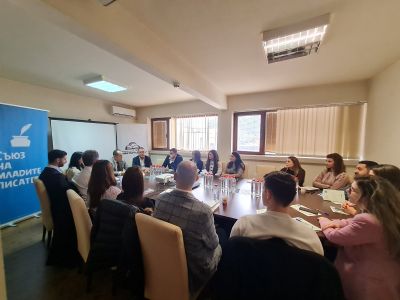
The training combined expert input with group work, simulations, and peer discussion. Sessions explored what it means to be European today, the protection of human rights in Bulgaria, responsible freedom of expression, and decision-making in an environment shaped by disinformation and artificial intelligence. The program was supported by experienced trainers and practitioners from the fields of youth policy, human rights, journalism, media literacy, public administration, and facilitation.
The project trained 21 young leaders, exceeded its publication target with 15 outputs, and reached wider audiences through social media, websites, local and national media, and radio.
One clear result was visible in the experience of a young participant who began the training with limited knowledge of EU rights and values and little confidence speaking in public. Through interactive sessions, group discussions, and small-group presentations, she became more active and assured. By the final session, she delivered a short speech about her impressions from the training with clarity, receiving positive feedback from trainers and peers. She later shared: “I never thought I could speak in front of others with confidence.” The training also helped create a new network of young people from the region, who later organized two follow-up meetings on their own initiative in Montana and Vidin.
The initiative offered a useful model for civic education in regions where young people often have few opportunities to participate in public life. By linking European values with local identity and historical memory, the project made civic learning more concrete and easier to relate to. The Bulgarian School of Politics “Dimitry Panitza” and the Union of Young Writers plan to keep the project website and video lessons available, so that the materials can continue to support young people and civic organizations after the end of the grant period.
The project European Values and Cultural Identity of Young People from Northwestern Bulgaria, supported by the Engaging Central Europe program of the Transatlantic Foundation, was implemented under the PROTEUS program and co-funded by the European Union.
The views and opinions expressed are solely those of the author(s) and do not necessarily reflect those of the Transatlantic Foundation (TF) or the European Union (EU). Neither the EU nor TF can be held responsible for them.