The Europe-India Briefing—October 2026

Listen to this article
Audio is generated automatically and may contain minor inaccuracies.
New Geographies
Poland is positioning itself as the key interlocutor for India in Central and Eastern Europe
We noted in our last newsletter that Polish Prime Minister Donald Tusk is likely to visit India this year. The visit is now official and is scheduled for October 22–24. Tusk will travel to New Delhi and Bangalore with a large delegation including his minister for finance and economy, and, according to some reports, representatives from around 100 leading Polish companies.
This will be the first prime ministerial visit from Poland to India in over 15 years. Interestingly, Tusk was also the last Polish Prime Minister to visit back in 2010. In between, ties remained friendly but on the back burner. Russia’s invasion of Ukraine in 2022 shifted the equation. Given India’s relationship with Russia, outreach from European capitals to New Delhi went into high drive. India also deemed it important to engage Poland as a key EU and NATO-frontline state supporting Ukraine. Warsaw played a critical role in evacuating around 4,000 Indian students stuck in Ukraine on the eve of the invasion.
It is in this context that Prime Minister Narendra Modi went to Warsaw in August 2024, the first Indian Prime Minister to visit the country in 45 years. A senior Polish official I spoke to termed the visit “truly historic” and shared that the Polish government was keen to follow up with their own visit soon after.
Business First
A second factor behind this visit is the EU-India free trade agreement (FTA), which has changed the way many European capitals, including Warsaw, view New Delhi. This visit will focus largely on business and economic ties, setting up Polish companies to capitalize on the opportunities the FTA promises to provide. Given that Poland is the fastest-growing economy in Europe and the sixth-largest EU economy, it is an important partner for India to engage with. Poland-India trade has seen a sharp increase in the last few years (See Graph 1).
India is the second-largest target market in Asia for Polish investment. India’s capital footprint in Poland is larger—valued at approximately $3 billion. Some of the largest Indian investors and employers in Poland include technology and services giants such as Tata Consultancy Services, Infosys, Uflex, HCL Technologies, and Wipro.
India-Poland Trade, 2015-2025 ($ million)
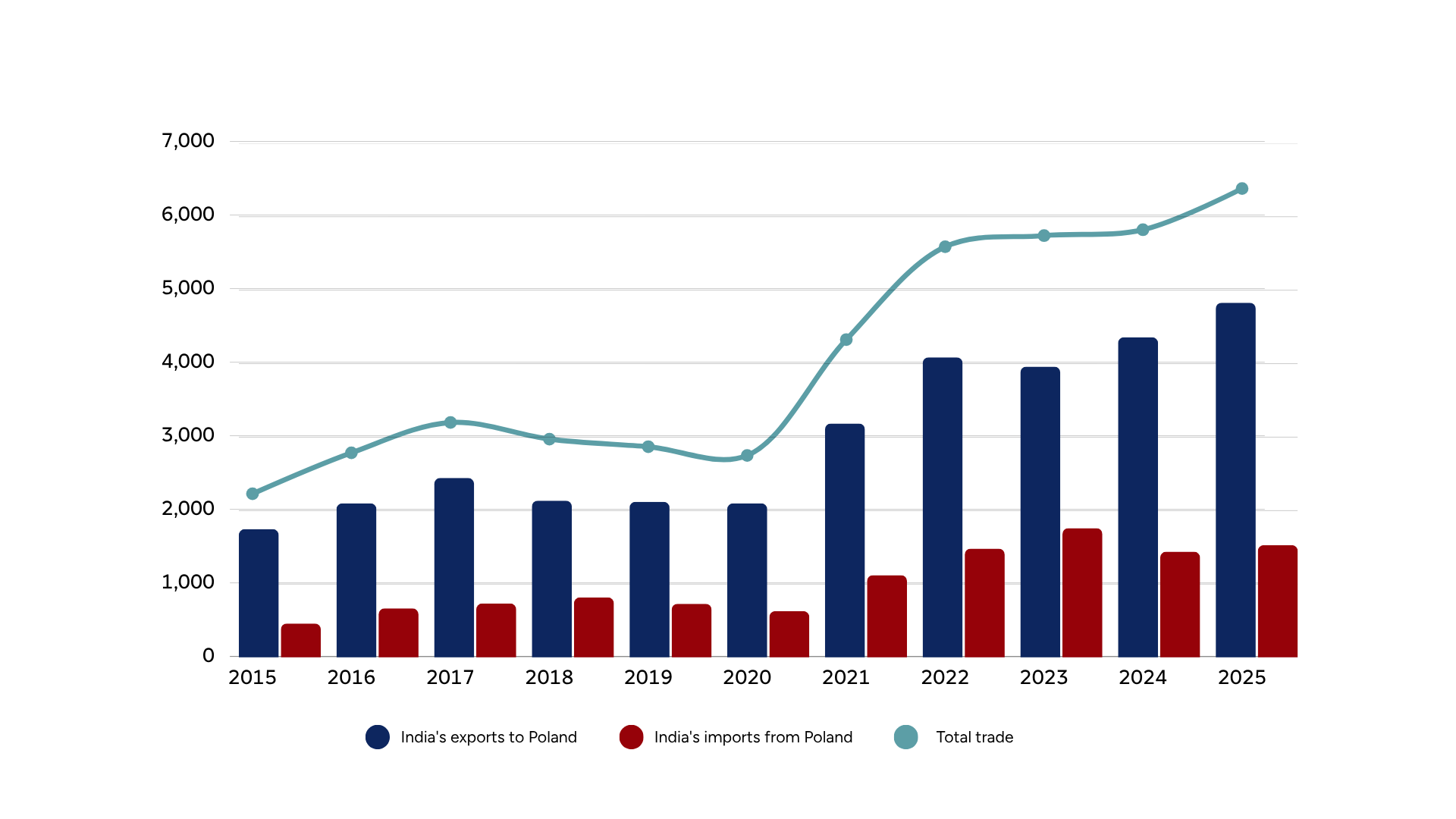
Graph 1: Bilateral Trade in Goods between India and Poland (Data from the Ministry of External Affairs, India-Poland Relations Brief)
In addition to trade and investment prospects, economic security concerns are also driving this visit. “Trade wars and tariffs have forced us to go global and look for trusted partners we can work with”, a Polish official remarked. India, with its impressive economic growth rate and large market, is “a natural partner”. Tusk and his delegation will visit New Delhi and Bangalore—India’s Silicon Valley—where they will focus on traditional sectors of cooperation between Poland and India such as machinery and mining as well as new ones such as space, AI, and defense. The economic piece will “drive the political dimension of this visit”, my sources told me, particularly as supply-chain security becomes paramount for both India and Poland.
A New Political Interlocutor
On the political side, Tusk’s role as president of the European Council from 2014–2019 and longest-serving European prime ministers make him an important interlocutor and counterpart for Modi. Their meeting will take place right after the publication of the joint French-German letter to European Commission President Ursula von der Leyen on China and the visit of the EU Trade Commissioner Maroš Šefčovič to Beijing. These two developments underline a “new consensus in Europe and a readiness to defend homegrown industries, even if this triggers a forceful Chinese response”, Noah Barkin has noted. They also deepen Europe’s convergence with India’s own China policy and economic security strategy. Speaking in Warsaw in September, Indian Foreign Minister Subrahmanyam Jaishankar characterized India’s engagement with Europe as part of New Delhi’s own strategy of “de-risking and diversifying”.
Defense Focus
Finally, India’s relationship with Russia has been a bigger concern for Central and Eastern European countries than for Western European partners. When I asked Polish government officials how this might impact their ambitious upgrade of ties with India, many seemed realistic that they could not change New Delhi’s historical ties with Moscow. Instead, they want to emphasize that Europe can be a “trusted alternative” for India in certain arenas. This visit will focus on defense-industrial cooperation, including joint production and common platforms, as well as on collaboration on port infrastructure, shipbuilding, and marine technology—all of which have dual-use elements.
The visit will also include information-sharing, including about Russian hybrid attacks in NATO countries. This is important for India, especially as the Indian diaspora in Europe is growing. An Indian national was killed in early September during attacks on Kiev.
What to Watch
- The victory of the far-right Alternative for Germany (AfD) in the German State of Saxony-Anhalt in September this year represents an “electoral earthquake” that has “fractured Germany’s societal and political tectonic plates”, according to my GMF colleagues. For India, there are multiple reasons to closely watch this trend and AfD’s rise. First, these election losses have intensified pressure on German Chancellor Friedrich Merz’s governing-coalition in Berlin. Second, the anti-immigrant sentiment that propelled this electoral victory could also have an impact on India’s growing diaspora in Germany. According to a recent report, between 2005 and 2015, the number of Indian nationals residing in Germany more than doubled—from 40,000 to 86,000. At the beginning of 2025, there were around 280,000 Indian nationals living in Germany as permanent residents. Indian students are also the largest group of international students in Germany, having recently surpassed students from China.
- Modi is likely to visit Brussels in mid-December to sign the EU-India FTA. This will be only his second visit to the city since taking office; the last one was more than a decade ago in March, 2016.
This edition’s interesting fact: During World War II, an Indian Maharaja, the Jamsaheb of Nawanagar, provided shelter to over a thousand Polish children. He is memorialized at the Square of the Good Maharaja in Warsaw.
The next edition of the Europe-India Briefing, the last one for this year, will focus on Brussels, next steps for the FTA, and defense and technology cooperation with India.Follow and subscribe to get the next edition in your inbox.
The views expressed herein are those solely of the author(s). GMF as an institution does not take positions.