A Practical Framework for Democratic Resilience
Author: Dimitar Keranov, Transatlantic Foundation
Strategic corruption is not always visible as a single scandal, a clear bribe, or an easily traceable abuse of power. In many cases, it works more quietly: by creating dependencies, shaping incentives, weakening oversight, distorting public decision-making, and reducing the ability of democratic institutions to act independently. In this sense, strategic corruption can be a dangerous instrument of hybrid warfare, capable of weakening democratic resilience from within.
This was the starting point of the project of the NEST Institute, titled Analytical Framework for Monitoring Strategic Corruption in the Context of Hybrid Threats.
The project focused on developing a practical analytical framework for the systematic monitoring and early detection of the misuse of public finances and economic instruments as part of strategic corruption. Its aim was to help civil society, watchdog organizations, analysts, journalists, experts, and public institutions better recognize risks that often remain below the threshold of a “classic” corruption case but may still have serious consequences for democratic resilience and national security.
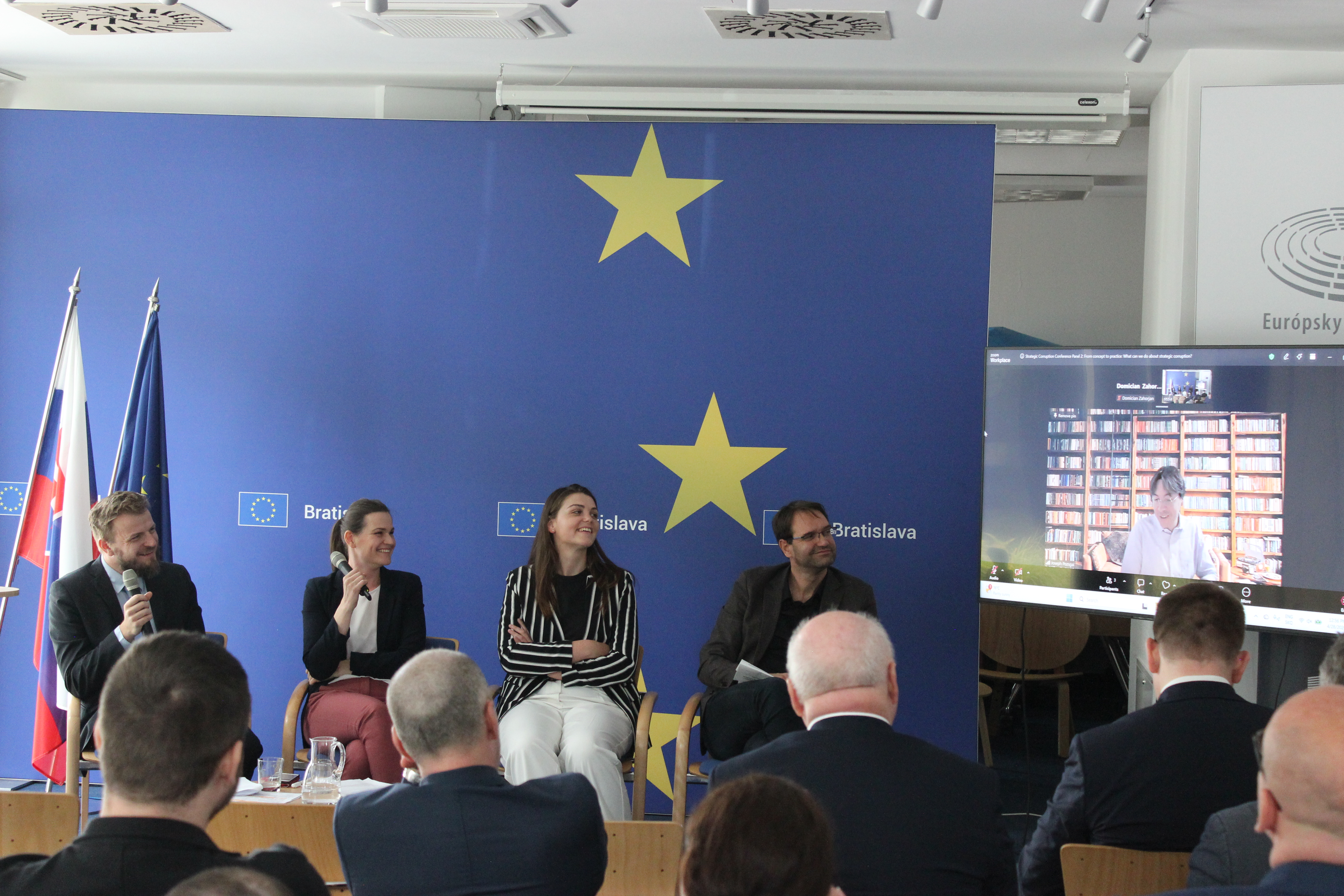
Photo credit: NEST
Strategic corruption is particularly difficult to address because it often does not rely on one smoking gun. Instead, it may appear through a combination of indirect indicators: suspicious financial flows, preferential treatment, dependency-building, opaque decision-making, market lock-in, narrative influence, or the weakening of institutional safeguards. The project’s analytical framework therefore works with patterns, indicators, and convergence of evidence. It helps users ask not only whether corruption has occurred but also whether a broader pattern of influence is emerging.
Over the course of the project, the NEST Institute combined analytical mapping, expert consultations, regional discussions, and pilot testing. The final publication brings together the analytical framework, selected pilot cases, and recommendations for public policy. It is designed as a practical tool that can be used, tested, and further adapted by organizations and institutions working on public integrity, democratic resilience, and hybrid threats.
One of the main lessons of the project is that even complex concepts can be communicated if they are connected to real-life risks. Strategic corruption becomes easier to understand when it is explained through public procurement, energy dependence, strategic infrastructure, media influence, foreign-backed networks, or the misuse of public funds. The project also showed that there is a strong need to connect communities that often work separately: anti-corruption experts, security analysts, journalists, civil society actors, academics, and public officials.
The response to the project confirmed that strategic corruption is not an abstract topic—it is a practical challenge for democratic societies. It shows how corruption can be used not only for private enrichment but also as a tool for building influence, creating dependence, and weakening institutions from within.
The project continues beyond the publication. The NEST Institute is now working on educational activities in which strategic corruption will be one of the training topics for selected public-sector and political actors. The framework will therefore be tested further in practice and used as a basis for capacity-building.
The first signs of longer-term impact are already emerging. Analysts and researchers have begun to work with the methodology and explore ways to translate it into practical tools, including applications that could support monitoring, mapping, and early detection of strategic-corruption risks. This confirms one of the project’s core ambitions: to create a framework that does not remain on paper but can continue to evolve, be tested, and support those working to protect democratic resilience, public integrity, and strategic autonomy.
The project Analytical Framework for Monitoring Strategic Corruption in the Context of Hybrid Threats, supported by the Engaging Central Europe program of the Transatlantic Foundation, was implemented under the PROTEUS program and co-funded by the European Union.
The views and opinions expressed are solely those of the author(s) and do not necessarily reflect those of the Transatlantic Foundation (TF) or the European Union (EU). Neither the EU nor TF can be held responsible for them.