How a Ukrainian Civic Organization Has Been Fighting the Information War Over Crimea
Crimea Center is a Ukrainian civic organization that has been working on Crimea-related issues since the 1990s. It spent its early years fighting for Ukrainian-language education and Ukrainian cultural identity in a region where Ukrainians were a minority. After Russia’s illegal annexation in 2014, it relocated to Kyiv and transformed its work. Today, it monitors Russian propaganda, documents human-rights violations, and runs Holos Krymu (Voice of Crimea), an independent Ukrainian-language media outlet covering the occupied peninsula. We spoke with Andriy Shchekun, member of Crimea Center’s board, and Liudmyla Shchekun, editor-in-chief of Holos Krymu, about what it means to resist an occupation from a distance, and why the information war over Crimea is far from over.
Tell us about Crimea Center’s activities before the occupation.
Andriy Shchekun: We founded it in 1999 in Bakhchysarai, where we lived at the time. Our goal was to foster Ukrainian national identity and develop Ukrainian-language education—at that point, a fundamental problem in Crimea, the only region of Ukraine where Ukrainians are a national minority. At the time, Ukrainians made up 24% of the population, and Crimean Tatars around 13%. The dominant Russian and pro-Russian community made it difficult for Ukrainian-language education and Ukrainian culture to develop. Our organization brought together people who wanted to change that.
By 2009, we had grown into an all-Crimean organization. We succeeded in establishing around 600 school classes taught in Ukrainian and founded the only Ukrainian-language media outlet in Crimea at the time. We also supported the Ukrainian Orthodox Church of the Kyiv Patriarchate.
When the Revolution of Dignity began, we coordinated the local support movement: Euromaidan-Crimea. And in 2014, we led the resistance to the occupation of Crimea.
How did that unfold?
Andriy Shchekun: We organized peaceful rallies near the monument to Taras Shevchenko in Simferopol, which helped break through the information blockade.
The occupiers were broadcasting that everyone in Crimea was happy, showing only pro-Russian expressions of support. But our rallies drew, by various estimates, up to 2,000 people.
The Russians hadn’t expected that, but they quickly adapted and began kidnapping activists and resistance organizers. I was among those seized—one of the first taken captive, but also one of the first to be exchanged.
I was captured on March 9, 2014 and exchanged on March 20, along with around 45 other people.
After that, many had to leave Crimea. But we decided that the information war is also an important war, and that remains true to this day.
We analyze and monitor Russian propaganda, write analytical pieces, document crimes, and pass the information to the Prosecutor’s Office of the Autonomous Republic of Crimea and the city of Sevastopol, as well as to the Main Directorate of the Security Service of Ukraine. Thanks to our information, criminal proceedings have even been opened.
How did your team navigate these transformations—occupation, resistance, forced departure from Crimea, new challenges?
Andriy Shchekun: It was genuinely very hard because we were forced to leave everything behind. You have three underage children and have to start from scratch—renting housing and so on. Everyone faced the same problems. As an organization, we managed to have displaced persons from Crimea housed in a sanatorium near Kyiv, and some still live there. We tried to support our members in every way we could, while also working a great deal ourselves, driven by a naïve belief that Crimea would return in a couple of years. I no longer hold that belief. As early as 2020, I began to think that the return of Crimea could take 20 years, and that it would most likely happen only after the collapse of Russia.
But we understand that we need to return, even if only to the graves of our family members there. That is what we work for. We are the people who want to build a new Crimea with a Ukrainian national identity—and to do it together with the Crimean Tatars.
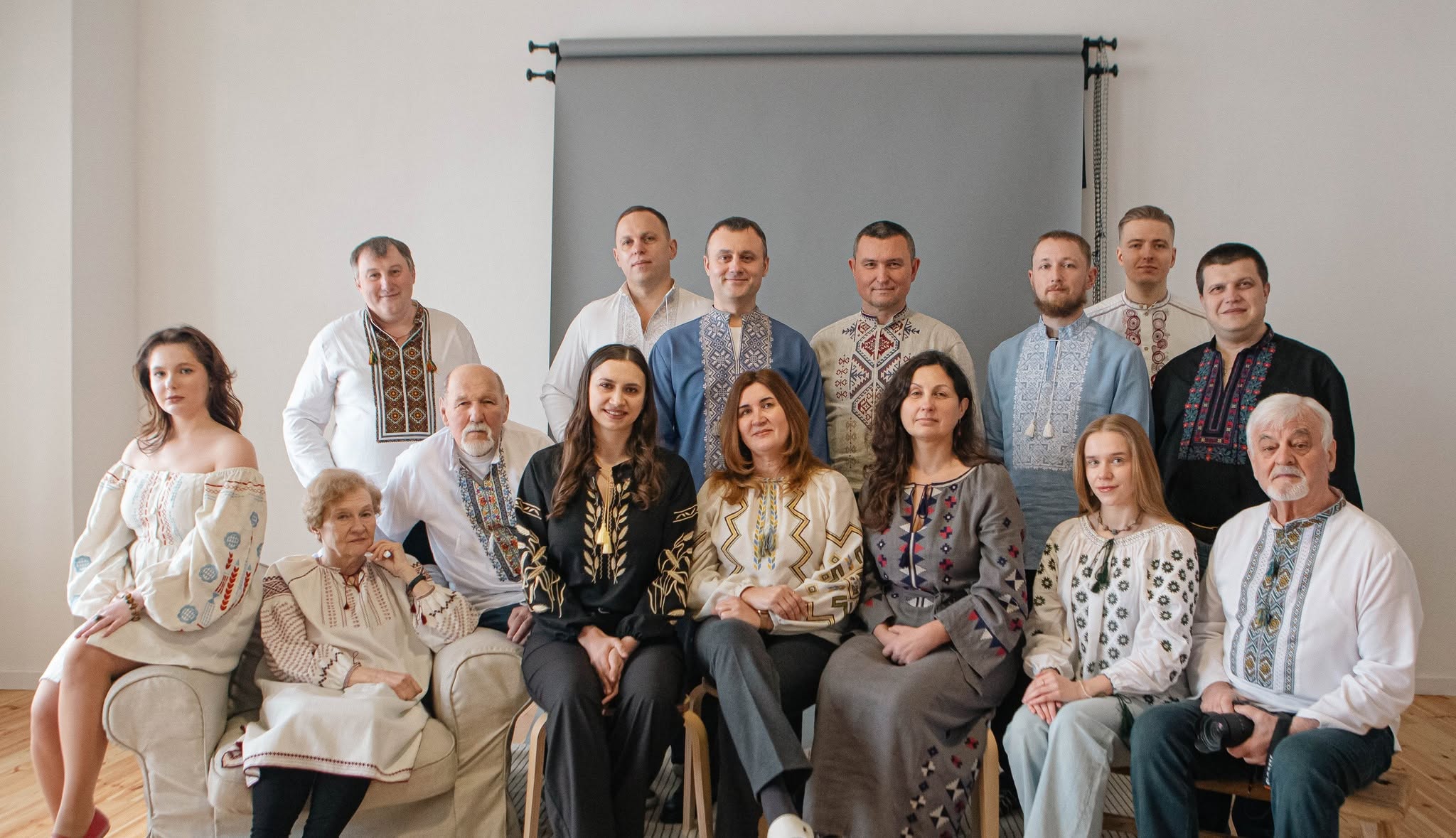
Photo credit: Crimea Center
In 2022, the situation in Crimea didn’t change as dramatically as in the rest of the country. But how was that period for you, already in Kyiv?
Andriy Shchekun: Before the full-scale invasion, some people could still travel freely to Crimea. They even managed to bring our newspaper there. For their safety, they were not official members of the organization, but they carried out certain tasks for us. We lost that connection after the full-scale invasion. Only a handful of people today still have access to the territory of Crimea.
Within Crimea itself, the FSB [Russia’s security service] became more active in identifying pro-Ukrainian activists—the number of arrests increased hundreds of times over. Recently, we learned that one of our members is being held in a prison in Rostov-on-Don. We had no idea what had happened to him when he stopped making contact, and then we recognized him in a video from occupation media outlets.
As for our team in Kyiv, at the start of the full-scale invasion, most of us relocated to Lviv, connected with humanitarian organizations, and set up an aid hub. We volunteered for several months. Some members joined the army. Over time, we began returning to Kyiv.
Tell us about the media side of your work, the news outlet Holos Krymu (Voice of Crimea). Is the goal to draw attention to Crimea at the national level?
Liudmyla Shchekun: Our goal has always been the same—to ensure that Ukrainians do not separate Crimea from the rest of Ukraine, that they understand we have far more in common than might appear.
That undermines the narratives of Russian propaganda, which exploits precisely this, sowing doubt about whether Crimea is truly Ukrainian. Moscow has long invested in the Russian community in Crimea. Türkiye supported the Crimean Tatar community. Ukraine should have done the same for Ukrainians in Crimea.
So we have an interesting symbiosis of a civic organization and a media project—working not only with current news, but also with the broader history of Crimea.
Our projects also involve documenting crimes.
We conducted in-depth interviews with educators—including school principals who gave detailed accounts of named collaborators and of how Russian-style education was introduced into Crimean schools—and forwarded the information to the Prosecutor’s Office and the Security Service of Ukraine. But this is a vast body of work. We have only scratched the surface.
We constantly monitor Crimean media to understand what processes are unfolding there. Our focus is on education, the militarization of society, and labor migration. They are trying to bring as many people from Russia into Crimea as possible. We also track how, under the pretext of restoring cultural heritage, they are in fact destroying it, and how they conduct illegal archaeological excavations. We have a pool of experts who know Crimea very well, having previously lived and worked there in government, education, or the economy. In short, they know all the inner workings.
We naturally never let go of the subject of Ukrainians in Crimea, and we have been covering this since Ukraine’s declaration of independence in 1991.
Do you have any collaboration with national media? Do they sometimes pick up on your topics?
Liudmyla Shchekun: Sometimes they do, but usually current news rather than anything historical. Though it was important for us to tell the story of the Ukrainian community in the 1990s. One story that did reach national news was that of our activists who visited the Lesya Ukrainka Museum in Yalta and found almost nothing remained of it.
We always try to write not just about what happened, but to provide context and analysis. That is harder to do, and not everyone finds it interesting. On the positive side, our Telegram channel has around 40,000 subscribers, which is substantial for a regional outlet. We are also developing our YouTube channel.
We track which Russian politicians visit Crimea, what they come with, and how those meetings end—whether they sign cooperation agreements, what they say. We also monitor how Russians actively fund cultural projects, knowing that culture can be used to brainwash people and create soldiers who don’t think but simply follow orders. Monuments are being erected at a frantic pace, memorial plaques hung on schools, and so on. All of this is what we study, because only by grasping what is happening there can we plan what to do when Crimea returns.