The Europe-India Briefing—Inaugural Edition


Listen to this article
Audio is generated automatically and may contain minor inaccuracies.
We are delighted to welcome you to the inaugural edition of The Europe-India Briefing, the first newsletter tracking the evolving and dynamic Europe-India relationship. To sign up for the newsletter, please click here.
In this bimonthly newsletter, we will provide exclusive insights and a behind-the-scenes look at the trajectory of this unique partnership based on conversations with representatives of governments and industry in Brussels, other European capitals, and New Delhi.
—Garima Mohan, Senior Fellow, GMF Indo-Pacific Program and lead, GMF India Initiative
—Tara Varma, Managing Director, GMF Strategic Foresight
Europe’s Moment in the (Delhi) Sun
By Garima Mohan
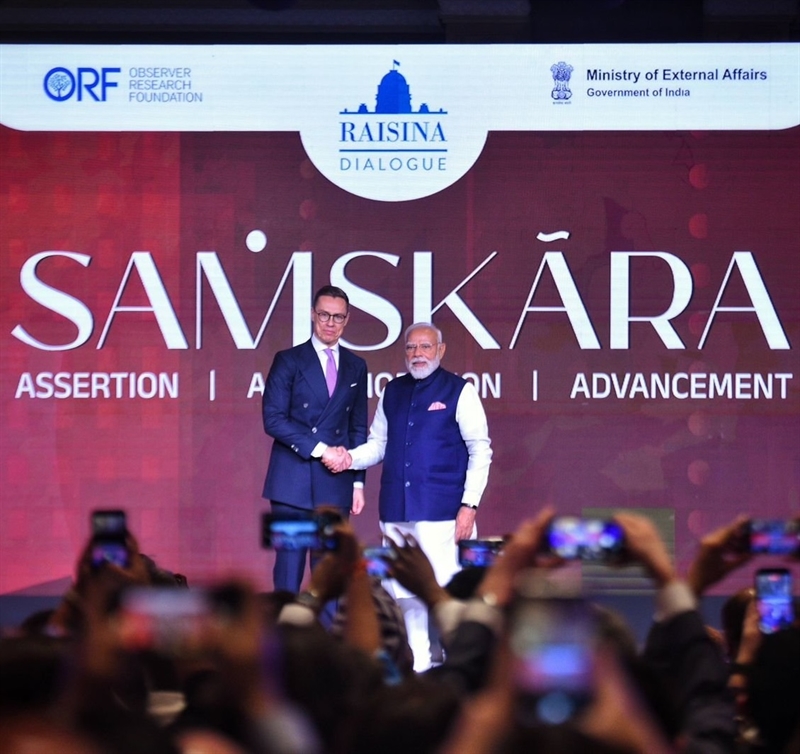
I’ve just come back from the 11th Raisina Dialogue—India’s premier foreign policy conference, held annually in New Delhi—and my clearest takeaway is that Europe’s moment in the sun continues.
This year started on a high note for Europe-India ties with the announcement of the EU-India Free Trade Agreement (FTA)—something that many longtime observers of the relationship thought would never see the light of day—as well as a security and defense partnership circumventing differences on Russia and a string of high-profile visits from various European leaders to New Delhi.
The Year of De-risking
A senior Indian official recently noted in a private briefing that while 2025 was a year of shock, 2026 will be for de-risking and diversification. Europe’s place in this strategy is clear. The Indian Ministry of External Affairs’ (MEA) webpage about incoming visits is populated by European leaders. The year started with a visit from German Chancellor Friedrich Merz, his first to Asia and to a non-NATO ally. This was followed by a visit from European Commission President Ursula von der Leyen and Council President Antonio Costa, who were guests of honor at India’s Republic Day in January. Then came French President Emmanuel Macron, who inaugurated India’s AI Summit in February, and Spanish Prime Minister Pedro Sanchez. Not counting the dozen ministers who visited Delhi for the AI summit, the Finnish President Alexander Stubb was the fifth European head of state or equivalent leader to visit India this year. Stubb also inaugurated Raisina Dialogue.
Europe has had a mixed relationship with Raisina. Even through the European delegations are among the largest overall, the main stage of the conference has often been used to air criticisms of European policies. Main-stage panels spotlighting Russian speakers have also led to disquiet among European delegates.
This year, the mood was decidedly different. Credit also goes to Stubb, whose opening keynotehighlighting "values-based realism" together with his nod to strategic autonomy, confidence in India’s global role, and critique of Europe’s propensity to lecture played perfectly to the audience. The key messages from his speech are very much in line with those delivered by von der Leyen and Macron earlier this year stressing the importance of India as a “trusted” partner in turbulent times.
Managing the Relationship with the United States
Speaking of turbulence, while the mood in Delhi was upbeat on Europe, tensions with the United States were evident. Ties between New Delhi and Washington are slowly getting back on track after being in deep freeze for almost all of last year. The long-delayed trade deal is expected to be concluded by the end of March 2026. However, Deputy Secretary of State Christopher Landau’s remark at Raisina that Washington "is not going to make the same mistakes with India that [it] made with China twenty years ago" underscored that even reaching a trade deal won’t ensure smooth sailing in bilateral ties. In addition, the sinking by a US submarine of an Iranian ship in the Indian Ocean as it was returning from a naval exercise hosted by India, and statements from Washington on India’s purchase of Russian oil showed that the work of rebuilding trust will take a long time. Overall, my conversations with Indian policymakers and those in Brussels reflected the same assessment: The United States is an indispensable partner, and European and Indian governments must now manage this relationship and the uncertainties and volatilities associated with it, while investing in other partnerships.
Middle Power Alignment
There’s also a growing alignment between India and Europe over the fallout of the Iran war. Safeguarding against energy costs and shipping risks, and in India’s case, maintaining the security of its over 9 million-strong diaspora in the Middle East, are pressing concerns. Meanwhile, Iran has also brought out fresh transatlantic tensions as European leaders were not warned of the US-Israeli strike and were not consulted post-facto on coordinating responses. India’s foreign minister Jaishankar is in Brussels this week joining the meeting of council of EU foreign ministers. While this visit was planned in advance and focused on the implementation of the EU-India summit agenda from earlier this year, Iran and energy security dominated conversations. Underscoring India’s decisive pivot to Europe, Jaishankar met with many of his European counterparts and stated that "in a multipolar and uncertain world, the India-EU partnership will act as a factor of stability and resilience."
What to Watch
Below is a list of things to watch, including takeaways from the European visits to Delhi, and what policy makers in New Delhi and Brussels told me they will be working on next:
- Next Steps for the FTA: On the EU-India FTA, EU officials told me that legal scrubbing of the text is expected to be finished by June and the actual agreement will likely be signed before the festival of Diwali in November. The next big challenge will be to ensure that the FTA is ratified by the European Parliament. While there are reasons to be optimistic—this FTA does not include sensitive sectors such as agriculture and is endorsed by all member states unlike the Mercosur agreement—it can still get dragged into party politics. Separately, the Investment Protection Agreement is still being negotiated with the Indian Ministry of Finance.
- TTC 2.0: Officials at the conference told me that a reform in the chronically underperforming EU-India Trade and Technology Council (TTC) is also expected: the TTC 2.0. It will focus more on advanced technologies such as semiconductors, biotech, and quantum and will likely be expanded to include business and private sector stakeholders.
- Upgrading Tech Partnerships: Technology has been front and center of all Europe-India meetings this year. Stubb’s visit focused on trade, technology, and talent flows, which have become the key pillars of the Finland-India relationship. Following the ban on Huawei, most of the 5G networking equipment used in India today comes from the Finnish company Nokia. France and India have also declared 2026 the year of innovation. I was told that Delhi is exploring an iCET/TRUST type format with Paris. A challenge here is that, while India would like to elevate its bilateral technology cooperation with European partners to the level of what is has with the United States, Europe remains uncertain about who the relevant actors are, how to build these formats, and which sectors to focus on.
- India-France Upgrade: France is always a step ahead of its European peers. During Macron’s visit, Paris and New Delhi upgraded already strong ties to a “Special Global Strategic Partnership” reflecting the “special and unique” nature of this partnership, with an annual foreign-minister-level dialogue added to the list of bilateral exchanges. Incidentally, France was the first Western country India signed a strategic partnership with back in 1998, as India’s Ambassador to Paris noted in Delhi in February.
- Defense-industrial cooperation: This is an area to watch with many more announcements expected this year. Macron’s visit saw the inauguration of Airbus’ H125 helicopter final assembly line plant in the southern state of Karnataka, which is considered a watershed for the Make in India program. Unlike previous helicopter production in the country, which involved public-sector companies, this line marks a significant private-sector entry into aerospace manufacturing. India also signed a contract to acquire 26 Dassault Aviation Rafale M carrier-based fighters, making it the first international buyer for the type’s “Marine” variant.
- Russian oil: Russia has been a constant source of disagreement between India and Europe. Given the war in Iran and the closure of the Strait of Hormuz, India—which is dependent on imports for 80% of its energy needs—will go back to buying oil and energy from Russia. The United States has “granted” India a 30-day waiver on the issue. However, it does look as though India has been able to score concessionsfrom Iran on India-bound vessels transiting the Strait.
Follow and subscribe for this bimonthly newsletter tracking developments in the Europe-India relationship. Our next edition will cover Modi’s visit to Norway for the India-Nordic Summit, the first such visit since 2022.