Mythos Cracks Digital Defenses


Listen to this article
Audio is generated automatically and may contain minor inaccuracies.
Welcome to the April edition of the TransatlanTech Insider.
Governments in the transatlantic alliance want to own, build, and grow AI capability. This month witnessed some of the most concrete steps in that direction.
When the Hacker Is the Machine: Since the ChatGPT moment, AI researchers and policymakers have zeroed in on one question: When will AI outperform humans on increasingly complex tasks? When it comes to cybersecurity, Anthropic appears to have an answer: Its Claude Mythos tool bests at least garden-variety digital intruders. The United Kingdom’s AI Security Institute found that, if given direction and network access, Mythos could execute multi-stage attacks and find and exploit vulnerabilities autonomously in a fraction of the time that human hackers could. Cyber attacks are already a tool of choice for state actors stealing intellectual property, conducting traditional espionage, and infiltrating critical infrastructure. And cyber offense versus cyber defense is a cat-and-mouse game.
Watch for:
- Cyber landscape shifts: whether AI disproportionately enhances cyber offense capabilities, or whether defensive tools that patch vulnerabilities can scale just as quickly.
- People’s Republic of China (PRC) AI development: how quickly PRC AI firms adopt and build out these tools and how closely they partner with the People’s Liberation Army (PLA)
- Trump-Anthropic détente: whether Anthropic and the Pentagon mend fences after the firm’s meeting with President Trump and its lawsuit challenging the supply-chain risk designation
AI Industrial Policy Turns Sovereign: Across the pond, the United Kingdom has launched a sovereign AI fund—a £500 million government-backed investment vehicle designed to support UK-anchored AI startups in competing globally. Run more like a venture fund than a traditional grant program, it pairs equity investments with access to compute, fast‑track visas, and national assets such as datasets and UK research.
Watch for:
- The rise of sovereign AI: how nations–especially in Europe–conceive of and define sovereignty as they aim to build national AI capacity and leverage the tools of the state to do so
- Sovereign procurement: whether realizing the UK government as a customer for British sovereign AI startups will require procurement policy that explicitly prioritizes national companies
- Scaling gap: whether £1 million to £10 million investments are enough to help UK startups scale and compete globally
In this edition, GMF Technology shares new work on transatlantic approaches to AI, opportunities for cooperation on international technical standards, and Ukraine’s efforts to de-risk its defense tech supply chains. Subscribe to receive future newsletter editions, follow us on X, and visit our webpage to learn more.
Featured this Month
Julia Tréhu and Adrienne Goldstein Highlight Opportunities for Transatlantic AI Cooperation
In some ways, the United States and Europe have never appeared farther apart on AI, and many see transatlantic tech relations as fractured by two increasingly incompatible approaches: The US innovates, Europe regulates. In practice, however, the picture is more nuanced. Lawmakers on both sides of the Atlantic are grappling with similar challenges on AI, and issues such as children’s safety and existential risk present opportunities for transatlantic cooperation.
Julia Tréhu and Adrienne Goldstein discuss these findings from GMF Technology’s Transatlantic Tech Exchange (TTX) in “Beyond ‘US Innovates, Europe Regulates’: Lessons and recommendations from a Transatlantic AI Exchange”. Drawing on insights from high-level meetings with European AI leaders, they recommend that the United States and the EU launch an AI dialogue to address issues of shared interest, invest in AI policy experts to advise lawmakers, and gather real-world data on the economic impacts of AI.
Alexandra Pugh Discusses US-Europe-Japan Technology Cooperation
Whoever writes the rules for emerging technologies helps determine who leads in the industries they create. The PRC’s push to incorporate polar codes into international 5G standards a decade ago was a boon to national champion Huawei—and a wake-up call for democratic nations unprepared to treat standards as a tool of geopolitical power. Yet the number of US leadership roles in ISO bodies has declined, and opportunities remain for greater coordination among like-minded partners.
Japan is moving to fill the gap. Tokyo’s 2025 New International Standards Strategy reflects a deliberate effort to shape global standards on emerging technologies in collaboration with like-minded partners.
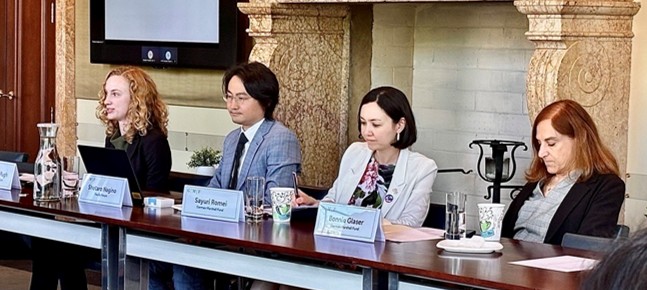
Program Coordinator Alexandra Pugh unpacked opportunities for US-Europe-Japan cooperation on standard-setting at a private roundtable hosted by GMF Indo-Pacific, serving as a discussant alongside speaker Shotaro Nagino of Pacific Forum and host and GMF Senior Fellow Dr. Sayuri Romei. Indo-Pacific Managing Director Bonnie Glaser gave welcoming remarks.
Dylan Welch Speaks on De-Risking Ukraine’s Defense Technology Stack

Ukraine reached a defense-industrial milestone last month: It can now produce some drones without PRC components. Over four years of full-scale war, Kyiv has undergone a shift toward self-sufficiency, from importing PRC drones to assembling drones using foreign parts and now toward reducing PRC inputs altogether. Even so, most Ukrainian drones still rely on PRC components, and Ukrainian officials stress the importance of continued de-risking to bolster supply chain resilience and develop Ukraine’s defense-industrial base as a geopolitical asset.
GMF China Technology Analyst Dylan Welch unpacked Ukraine’s de-risking efforts at a private roundtable co-hosted by GMF and the Snake Island Institute (SII). The event brought together SII’s Executive Director Maryna Hrytsenko and Director of Analytics Catarina Buchatskiy, along with a delegation of Ukrainian active-duty military personnel, for conversations with key Western stakeholders on the evolution of Ukrainian defense tech. GMF Strategic Democracy Initiatives Managing Director Josh Rudolph hosted the discussion.
Media Mentions
Lindsay Gorman in POLITICO on European Governments’ Move Away from WhatsApp
“This trend is about reconciling a difference between how official communications maybe should happen, and how they're in fact happening in practice”, Gorman said in “European civil servants are being forced off WhatsApp”. “The bigger move is just [addressing] the discrepancy between how government should communicate and how people just are communicating”.
Byte-Sized Bulletin
French AI startup Mistral raised $830 million in its first debt financing operation to fund a new data center near Paris that will run on NVIDIA GB300 chips. The deal marks a key achievement for Mistral, widely seen as one of Europe’s most promising AI firms, as it competes with better-funded US rivals.
The US Army is building a chatbot for soldiers named VictorBot that is trained on real-world military data. The move continues the US push for AI in defense after the US Department of Defense launched GenAI.mil late last year to bolster AI use among US service members, civilian employees, and contractors.
Greece is set to ban social media for children under the age of fifteen, joining countries such as Australia, France, and Denmark that have enacted or are considering similar measures. Officials plan to use the state-backed application Kids Wallet to restrict social media access.
The Ukrainian military captured Russian positions using unmanned platforms exclusively for the first time, Ukrainian President Volodymyr Zelenskyy said. Ukrainian ground robots have carried out more than 22,000 frontline missions over the past three months, he noted, highlighting the growing role of ground systems alongside drones in offsetting Russia’s manpower advantages.
Dutch regulators approved Tesla’s Full Self-Driving Supervised software, which powers self-driving cars with human supervision, the company said. The Netherlands is the first European country to sign off on the technology.
The Download
- GMF Technology co-hosted a dinner discussion with Danish Ambassador Jesper Møller Sørensen and the embassy of Denmark to explore opportunities for NATO allies to harness quantum innovation for security and warfighting applications. The dinner brought together US and Danish leaders across government, industry, and civil society.
- Lindsay Gorman spoke at a Yale University event titled “Shining a Light on the Uyghur Genocide: Presenting ‘China's Technogenocide’”, featuring Rushan Abbas of Campaign for Uyghurs, Director of the Yale Genocide Studies Program David Simon, and undergraduate capstone students. Gorman emphasized the value systems at stake at the heart of the tech global competition and the importance of tracking the evolution of PRC digital repression tools.
- GMF Visiting Distinguished Fellow Heli Tiirmaa-Klaar co-led a cyber diplomacy training workshop for UN diplomats ahead of the launch of the UN Global Mechanism on Advancing Responsible State Behavior in Cyberspace.
- Dylan Welch analyzed the PRC’s new roadmap for emerging technologies in Beijing’s 15th Five-Year Plan. He highlights the PRC’s focus on deploying AI as a general-purpose technology and developing industries around brain-computer interfaces, embodied intelligence, and other nascent technologies. Read the full article here.
- Next month, GMF Technology’s Transatlantic Tech Exchange will bring a delegation of members of European Parliament to Washington, DC and Boston, MA, to meet with government officials, innovators, and civil society representatives on public-interest AI.
GMF Technology is dedicated to ensuring that democracies together win the strategic technology competition with autocrats.
Alexandra Pugh coordinated this month’s TransatlanTech Insider.