Strengthening Taiwan, Strengthening the Democratic World: Three Chains for Taiwan–U.S.–Europe Security Cooperation
Listen to this article
Audio is generated automatically and may contain minor inaccuracies.
These remarks were presented by Dr. Chen Ming-chi, Taiwan Deputy Minister of Foreigni Affairs at the Taiwan Trilateral Forum in London, England, on September 10, 2026. Learn more about the Taiwan Trilateral Forum.
Opening
Thank you, Bonnie, and my thanks to the German Marshall Fund for convening this meaningful event. It is a great pleasure to join you today at the Taiwan Trilateral Forum.
The premise of this forum is increasingly important: Taiwan, the United States, and Europe do not face three separate security environments. We face one increasingly interconnected strategic environment, and the growing aggression of authoritarian powers across Eurasia.
Taiwan and Europe may be geographically distant, but what happens in the Taiwan Strait affects European trade, technology, and economic security. What happens in Europe shapes the strategic calculations of authoritarian powers in the Indo-Pacific. And the United States remains indispensable to the security architecture connecting both theaters.
So strengthening Taiwan is not an act of charity. It serves the direct interests of Europe and the United States, just as a secure and resilient Europe serves Taiwan’s interests.
Taiwan’s Foreign Minister Lin Chia-lung has described Taiwan as standing at the center of three strategically important chains. I would like to use these three chains to organize my remarks today—in an order that reflects the logic of security itself: first, the Indo-Pacific First Island Chain; second, the Global Supply Chain; and third, the Democratic Value Chain.
I. The Indo-Pacific First Island Chain
Taiwan occupies a critical position along the First Island Chain and sits beside some of the world’s most important sea lanes. Nearly half of global container-shipping capacity, together with major flows of energy, components, and semiconductors, passes through the Taiwan Strait or its surrounding waters.
A conflict in the Taiwan Strait would therefore not remain a regional event. Its consequences would be felt quickly in European factories, financial markets, energy security, shipping, and global technology production. Preserving peace and stability in the Taiwan Strait is therefore not simply an Asian security issue. It is a global economic and security interest.
Taiwan understands that deterrence begins with our own responsibility. Under President Lai Ching-te, Taiwan continues to increase defense investment and strengthen whole-of-society resilience. Our overall defense investment has reached more than 3.3 percent of GDP, and we plan to raise defense spending to 5 percent of GDP by 2030.
President Lai has also established the Whole-of-Society Defense Resilience Committee and integrated air-defense and civil-protection exercises into our Urban Resilience Exercise, bringing together government agencies, the military, civil-defense teams, local communities, and the private sector.
And this commitment is not limited to government. From 2021 to 2025, surveys conducted regularly by Taiwan’s Institute for National Defense and Security Research showed that more than 60 percent of respondents consistently expressed a willingness to defend Taiwan in the event of a Chinese military attack. A survey conducted this January by the American Portrait project at Academia Sinica reached a similar conclusion: even if the United States did not intervene militarily, nearly 60 percent said they would still be willing to resist at all costs.
These findings matter. Deterrence depends not only on weapons or military plans. It also depends on whether a society has the determination to defend itself. Taiwan is prepared to carry its own weight. 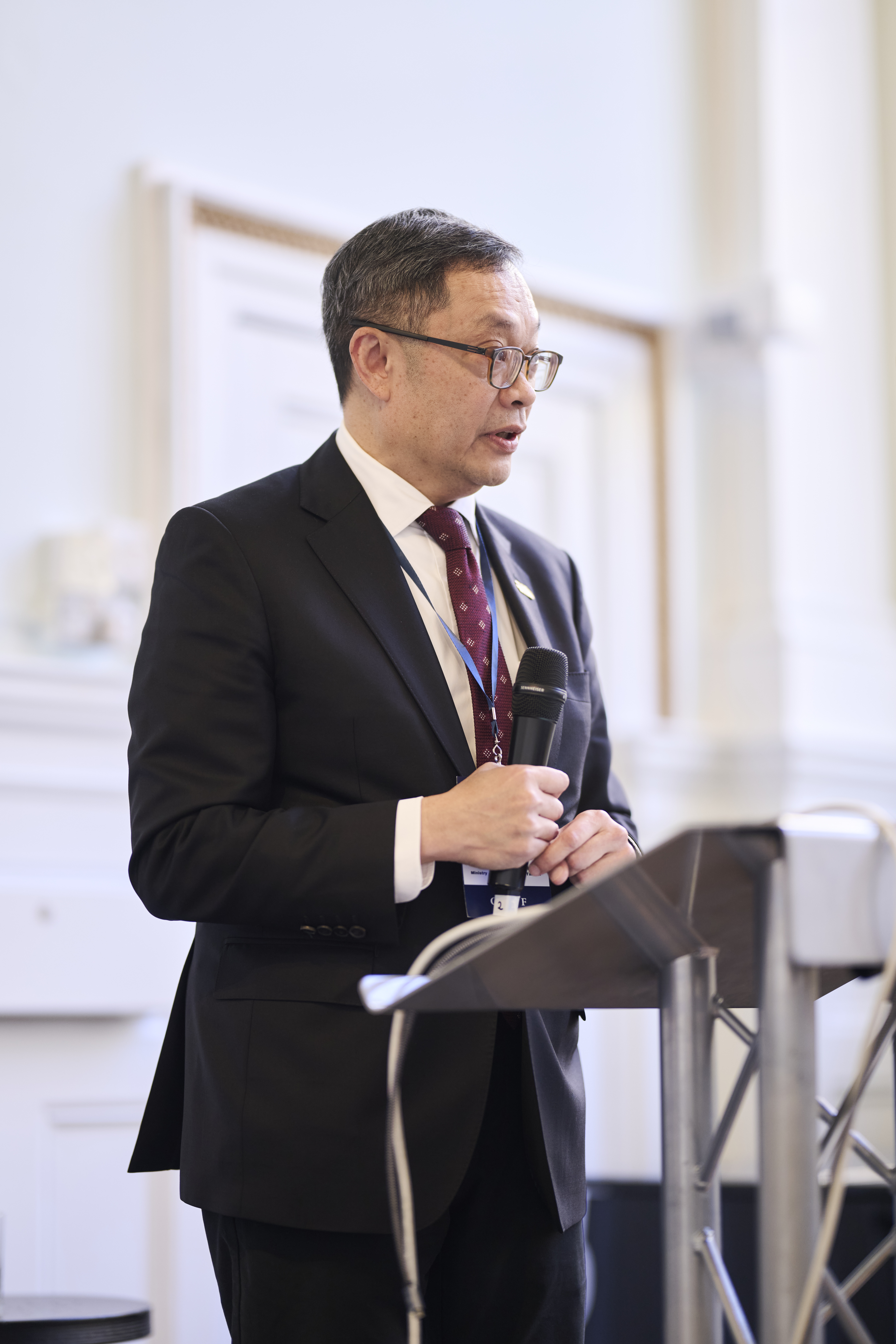
But self-defense and international cooperation are not alternatives. They reinforce one another. The United States continues to play the indispensable leading role in maintaining peace and stability in the Indo-Pacific. The traditional hub-and-spokes system remains an essential foundation of regional deterrence. At the same time, the security environment increasingly requires a denser network among allies and partners.
Europe can complement U.S. leadership and Taiwan’s own efforts. A visible European maritime presence, transits through the Taiwan Strait, closer security dialogues, exchanges on civil preparedness, cooperation on resilient communications and critical infrastructure, and coordination against gray-zone coercion all contribute to deterrence. Cybersecurity must be an integral part of this first chain as well. In a Taiwan contingency, cyber operations would not be separate from military coercion; they would likely be among its earliest instruments—targeting communications, energy, financial systems, government networks, and public confidence. Taiwan, the United States, and Europe should therefore deepen real-time cyber threat information sharing, exercises, protection of critical infrastructure, and cooperation on recovery and continuity of government and essential services.
The goal is not to reproduce NATO in Asia, but to create a stronger latticework: U.S. leadership, capable regional allies and partners, a Taiwan able and determined to defend itself, and meaningful European engagement.
II. The Global Supply Chain
Taiwan’s recent economic performance illustrates the scale of this transformation. Our economy grew by nearly 9 percent in 2025. Growth accelerated to about 15 percent in the first quarter of 2026 and remained close to 13 percent in the second quarter. Much of this momentum reflects global demand for AI, semiconductors, advanced computing, and related technologies. But there is another part of the story that is especially relevant to Europe: Taiwan’s gradual reduction of excessive economic dependence on China.
The political turning point came with the Sunflower Movement in 2014. Taiwanese society increasingly recognized that over-exposure to the Chinese economy was creating not only political vulnerability, but economic risk as well. After President Tsai Ing-wen took office in 2016, her administration began actively encouraging Taiwanese companies to hedge against China risk and diversify their investment and production. The New Southbound Policy was part of this broader effort, followed later by policies encouraging Taiwanese companies operating in China to invest back in Taiwan. This diversification did not weaken Taiwan’s economy. Quite the opposite. Together with Taiwan’s strengths in semiconductors, AI, and advanced manufacturing, reducing our excessive economic dependence on China has contributed to Taiwan’s remarkable economic performance in recent years.
The lesson is not that economic engagement with China must end. The lesson is that excessive dependence creates vulnerability. Taiwan learned this through experience. Europe is now confronting similar questions as China’s industrial overcapacity and non-market practices put pressure on European industries, while dependencies in critical minerals, components, communications, and advanced technologies can be weaponized through economic coercion.
This is why I prefer to speak of building a “non-red” supply chain. This does not mean complete decoupling from China, nor does it mean autarky. It means ensuring that the critical nodes of our economies are not subject to unacceptable strategic dependence on authoritarian states. The objective is resilience: trusted, diversified, secure global supply chains with fewer dangerous single points of failure.
Taiwan, the United States, and Europe should therefore coordinate more closely on export controls, investment security, supply-chain risk assessments, economic coercion, and the protection of critical and emerging technologies. We should also expand industrial cooperation in semiconductors, AI, drones, advanced manufacturing, energy resilience, telecommunications, and other strategic sectors.
TSMC’s investment in Dresden is a concrete example. Taiwanese investment contributes directly to Europe’s semiconductor capacity and industrial resilience. European equipment, materials, technology, expertise, and investment, in turn, strengthen Taiwan’s technological ecosystem. The United States is simultaneously becoming an even more important site of Taiwanese investment and advanced manufacturing.
This is what a resilient—and increasingly non-red—global supply chain should look like: not a retreat from globalization, but a reorganization of globalization around greater trust, reciprocity, diversification, and security. Taiwan’s own experience suggests that reducing excessive China risk can be compatible not with slower growth, but with greater innovation, investment, and prosperity.
The three parties represented here have complementary strengths: U.S. technological and security leadership; European industrial capabilities, equipment, research, and regulatory influence; and Taiwan’s advanced manufacturing and innovation ecosystem. Connecting these strengths is strategic insurance.
III. The Democratic Value Chain
The order matters. Military capabilities can deter aggression, and resilient supply chains can reduce vulnerability. But ultimately, what are we trying to protect? We are protecting societies in which people choose their governments, speak freely, innovate openly, and live under the rule of law.
Taiwan, the United States, and Europe are therefore connected not only by interests, but also by democratic values. Those values are increasingly challenged through military intimidation, economic coercion, cyberattacks, disinformation, foreign interference, and other forms of gray-zone activity.
Taiwan faces these pressures every day. Europe has confronted hybrid threats, sabotage and attacks on critical infrastructure, disinformation, and foreign interference. China’s support for Russia’s war effort in Ukraine further demonstrates that Euro-Atlantic and Indo-Pacific security cannot be neatly separated.
Europe has already sent important political signals. European naval transits through the Taiwan Strait, resolutions by the European Parliament and national parliaments, and statements by the European Union and the G7 all reinforce a basic principle: peace and stability across the Taiwan Strait are matters of international concern.
We hope Europe will continue to state clearly and collectively that unilateral attempts to change the status quo through force or coercion are unacceptable. But political statements should be matched by practical cooperation.
Taiwan, the United States, and Europe can deepen exchanges among officials, legislators, think tanks, experts, and civil society on counter-disinformation, cyber resilience, election security, critical infrastructure, crisis communication, and responses to gray-zone coercion.
This cooperation must be two-way. Europe has hard-earned experience responding to hybrid threats and building societal resilience. Taiwan has decades of experience confronting cyberattacks, disinformation, economic coercion, and sustained gray-zone pressure from China. We have much to learn from one another.
The Democratic Value Chain is therefore not an abstract slogan. It is an operational network of societies learning how to protect democratic institutions under pressure. Strengthening Taiwan’s democratic resilience strengthens the wider democratic community—and European and American resilience strengthens Taiwan.
IV. Connecting the Three Chains
The Indo-Pacific Island Chain connects our military, maritime, and cyber security and deterrence. The Global Supply Chain connects our economic and technological resilience—including our shared effort to reduce excessive strategic dependence on China. And the Democratic Value Chain connects the values, political resolve, and societal resilience that sustain both.
A vulnerability in one chain can weaken the others. Military coercion can disrupt supply chains. Economic dependence can constrain political choices. Disinformation can weaken public support for defense. Conversely, strength in one chain reinforces the rest.
That is why trilateral cooperation matters. Taiwan, the United States, and Europe should not approach security, economic resilience, and democratic resilience as separate policy files. We should increasingly connect them.
By linking U.S. leadership, greater European engagement, Taiwan’s own commitment, and the capabilities of other like-minded partners, we can make deterrence more credible, supply chains more resilient, and our democracies harder to coerce.
Conclusion
Strengthening Taiwan serves Europe’s interests because European and Indo-Pacific security are increasingly connected. It serves America’s interests because capable democratic partners are the foundation of sustainable U.S. leadership. And it serves Taiwan’s interests because our security depends on both our own determination and the strength of the international community around us.
The outcome of the war in Ukraine is especially important. Ukraine must be able to prevail against aggression. This is not only about European geopolitics. It is also about the credibility of deterrence and the future of the international order.
If democracies demonstrate that aggression does not pay—that free societies can remain united, sustain the costs of resistance, and ultimately prevail—that message will be heard far beyond Europe, including in Asia.
Across the Indo-Pacific Island Chain, the Global Supply Chain, and the Democratic Value Chain, our task is the same: to build enough strength, resilience, and solidarity that no authoritarian leader concludes that force or coercion is the easier path.
Thank you.