TransatlanTech Insider—February 2026 Edition


Listen to this article
Audio is generated automatically and may contain minor inaccuracies.
Welcome to the February edition of the TransatlanTech Insider.
In Munich this month, US Secretary of State Marco Rubio struck a softer tone with European allies, reflecting on a shared heritage and calling for “a new Western century”. But the core message—Europe must change—remained. Rubio warned of a “fear of technology” and articulated a vision for “an alliance that boldly races into the future”. He highlighted artificial intelligence (AI), critical minerals supply chains, commercial space travel, and industrial automation as areas for transatlantic tech cooperation.
Here’s what to watch:
- The Regulatory Ratchet—EU Information and Communications Technology (ICT) Supply Chain Security: The EU has unveiled a new ICT Supply Chain Security Toolbox and two detailed industry risk assessments on connected and automated vehicles and border detection equipment. Use of the toolbox is voluntary for now, but it is a basis for potential restrictions under a proposed revision to the EU’s Cybersecurity Act. The update would give the European Commission power to designate a "high-risk suppliers” list and ban their components, converting the nonbinding 5G toolbox from 2020 into hard law. If passed, the legislative package introduced would also require member states to build post-quantum cryptography migration into national cybersecurity strategies. Watch for which sectors get the next risk assessments, industry pushback as national-level requirements become real prospects, and the impact of European digital sovereignty concerns regarding US market domination of cloud services.
- A new risky American supplier? Anthropic and the Department of Defense: For its part, the Pentagon is considering declaring the US-based AI firm Anthropic a “supply chain risk”, a designation normally reserved for Chinese companies. At issue in the row may be setting limits on AI’s use. Anthropic, which has leaned into national security applications, does not want its technology used for mass surveillance on Americans or fully autonomous weapons. Defense officials insist on using the tech for “all lawful purposes” and accused the company of catering to a liberal elite workforce. Watch for a resolution, but also whether AI military governance debates get picked up in more appropriate and public forums than procurement negotiations.
In this edition, GMF Technology highlights our “Wired for Influence” tech stack event and shares readouts from Munich and New Delhi. Subscribe to receive future newsletter editions, follow us on X, and visit our webpage to learn more.
Featured this Month
GMF Tech Stack Report Launch

GMF Technology marked the Washington, DC launch of its latest tech stack research reports at Wired for Influence: Inside China’s Global Tech Playbook, an event that focused on the People Republic of China’s (PRC) global tech ambitions and their impact on allied security.
Congressman Mike Turner (Republican-Ohio) and Congressman Jim Himes (Democrat-Connecticut) kicked off the event with a bipartisan fireside conversation hosted by Lindsay Gorman. Next, Gorman welcomed former National Security Council Senior Director David Feith and Ericsson’s Emma Sävenborg for a panel discussion with GMF Technology’s Dr. Sharinee Jagtiani and Dylan Welch. The GMF colleagues highlighted key findings from their three tech stack reports on Germany, Serbia, and Central Asia (Kazakhstan, Kyrgyzstan, and Uzbekistan), which explore the PRC’s technological footprint across an advanced democracy, an EU candidate state, and a trio of emerging economies. GMF President Dr. Alexandra de Hoop Scheffer gave opening remarks, noting the tech stack research reflects the role of emerging technologies as a key driver of geopolitical power.
The conversations examined how the United States and Europe can work together to maintain global leadership and a competitive edge in critical and emerging technologies. Panelists spoke about the importance of resilience, noting that brittle US supply chains remain vulnerable to PRC coercion despite powerful American innovation ecosystems. Speakers also explored strategies to contest Beijing’s first-mover advantage in third countries, recognizing that breaking away from established tech vendors is challenging even with offers from technically superior competitors. Finally, panelists noted the crucial role of deployment at scale in driving innovation as industry invests earnings in next-generation research and development.
GMF Technology at the India AI Impact Summit
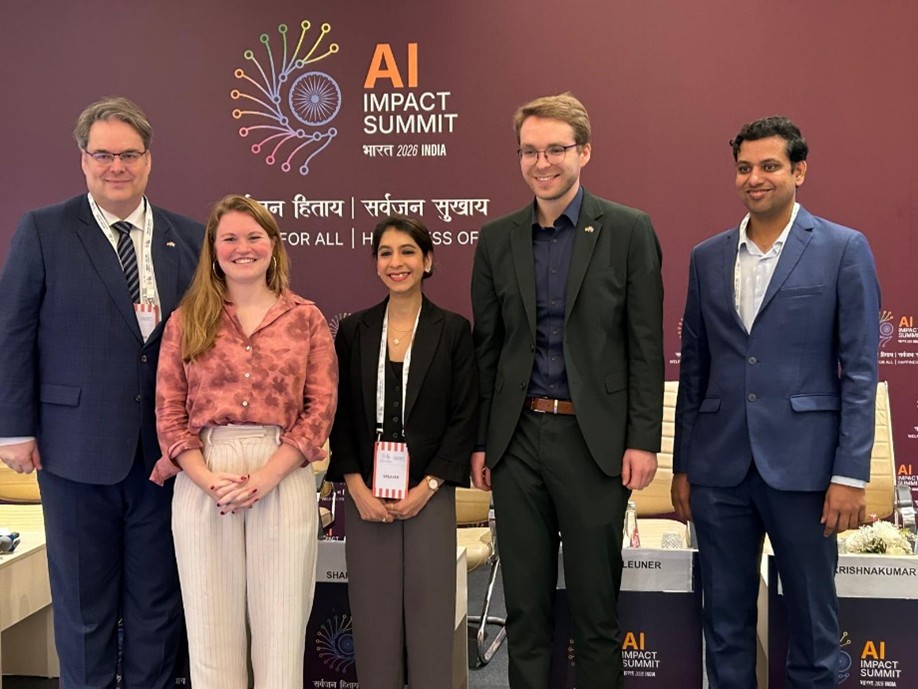
Global technology leaders gathered in New Delhi for the much-anticipated AI Impact Summit, which focused less on revisiting the risks of AI and more on accelerating its adoption. As host of the first AI Summit in the “Global South”, India is signaling a pivot in global priorities that builds on France’s 2024 handover but moves beyond the frameworks of previous convenings. New Delhi, by changing the branding from Paris’ AI “Action” Summit, is emphasizing large-scale, sector-specific AI deployment over the safety-centric approach that shaped earlier meetings in the United Kingdom and South Korea.
Senior Officer Dr. Sharinee Jagtiani was in New Delhi to take part in the conversations shaping the future of AI. At the summit, she participated in high-level discussions exploring AI sovereignty, the future of foreign policy in an AI age, and public interest AI and equitable access to compute. Jagtiani also analyzed India’s focus on AI deployment in a new piece, “Going Big on Applied AI”, which delves into New Delhi’s pivotal role in moving tech diplomacy from setting norms to shaping outcomes.
GMF Technology in Munich
As the Munich Security Conference set the scene for transatlantic relations in 2026, cyber resilience and quantum technologies ranked as important touchpoints at the intersection of emerging technology and the transatlantic relationship. The topics broached included:
- Cyber partnerships: Public-private partnerships are key for cyber resilience, particularly as state-sponsored malicious cyber activities continue to grow in scale and sophistication. Ensuring the continuity and security of essential services to the public requires a coordinated approach that leverages the operational expertise of national cyber agencies and the technological capabilities of the private sector. Visiting Distinguished Fellow Heli Tiirmaa-Klaar participated in a side event at the Munich Cyber Security Conference that explored strategies to strengthen the cybersecurity of critical infrastructure through deeper collaboration between governments and industry.
- Quantum defense priorities: As quantum technology moves from theoretical possibilities to real-world applications, assessing current gaps and future priorities for quantum adoption in defense is increasingly salient. Deputy Managing Director and Senior Fellow Astrid Ziebarth participated in a side event on quantum technologies for defense and security hosted by the Quantum Business Network.
Byte-Sized Bulletin
The PRC approved the sale of NVIDIA H200 chips, a victory for the country’s AI heavyweights seeking higher-end compute. The decision comes after President Donald Trump announced conditional approval of H200 sales to the PRC, with the US government taking 25% of sales.
As many as 1.6 million AI agents have joined the AI social network Moltbook, drawing global attention as they appeared to create a new religion, debate their existence, and consider creating a language humans couldn’t understand. The phenomenon sparked debates on singularity, the moment at which technology advances at a pace beyond human control, and highlighted emerging privacy and security concerns associated with agentic AI.
SPRIND, Germany’s federal innovation agency, announced its goal to build at least three frontier AI labs as Europe increasingly pursues technological sovereignty. Beginning this year, the agency’s Next Frontier AI Challenge will provide two years of compute, infrastructure, and other support to 10 teams selected to build frontier AI companies.
US Vice President JD Vance proposed a plan for a preferential trade bloc for critical minerals to a group of 55 countries including Australia, Germany, India, and Japan. The proposal follows the Trump administration’s launch of Project Vault, a strategic stockpile of critical minerals. Washington is seeking to reduce PRC geo-economic leverage stemming from its dominance in critical mineral processing.
The European Commission preliminarily found that TikTok breached the Digital Services Act with addictive features such as infinite scroll, autoplay, and personalized recommendations. TikTok stated its intent to challenge the finding, which the company described as a “categorically false and entirely meritless depiction”.
The Download
- Senior Program Coordinator Adrienne Goldstein judged a session of the Schuman Challenge, an academic competition designed to engage American undergraduate students on transatlantic issues. The 2026 competition prompted students to develop proposals for US-European cooperation on technology, defense, economic security, or Arctic issues.
- Deputy Managing Director Astrid Ziebarth attended “Europe and the Tech Oligarchs: Reclaiming Democracy and Sovereignty in the Digital Age”, a high-level technology conference in Turin organized by the European Council on Foreign Relations.
- Lindsay Gorman, joined by GMF Marshall Memorial Fellow alum Dr. David Bray spoke at a GMF Alumni Leadership Council briefing on the role of AI in geopolitical competition. Deputy Managing Director Astrid Ziebarth moderated the briefing.
- Lindsay Gorman spoke at a closed-door conversation on how AI is reshaping state power and strategic competition. The Stimson Center’s Reimaging Grand Strategy Program organized the event.
GMF Technology is dedicated to ensuring that democracies together win the strategic technology competition with autocrats.
Alexandra Pugh coordinated this month’s TransatlanTech Insider.