TransatlanTech Insider—March 2026 Edition


Welcome to the March edition of the TransatlanTech Insider.
Technology took center stage this month in geopolitics within and beyond the transatlantic context. Who owns, controls, exports, and derives strategic and economic value from artificial intelligence (AI) chips and counter-drone technology is increasingly defining corporate and nation state power. Will Europe move quickly enough to seize a piece of this pie?
Here’s what to watch:
Ukraine’s “drones as a service” go global: As war continues in the Middle East and assets ranging from oil facilities to shipping are threatened by Iranian drones, Ukraine is moving from security aid recipient to emerging defense technology exporter. According to President Volodymyr Zelenskyy, Kyiv has received requests from 11 countries spanning the North America, Europe, and the Persian Gulf for the expertise in advanced drone and interceptor technology that Ukrainian startups have pioneered. For four years, Ukraine has been a petri dish for modern warfare, honing its capabilities against Iran-made Shahed attack drones fired by Russia. Now that experience is in demand far and wide. Ukrainian defense technology firms are also innovating “drones as a service” business models aimed at foreign markets for continuous provision, operation, and hardware and software updates of interceptor technology.
- Watch for: whether Ukraine succeeds in turning sought-after technology into robust security partnerships, above all with the United States, and whether European nations move quickly to integrate Ukrainian knowhow into defense industrial buildouts.
AI chip whiplash: NVIDIA in the People’s Republic of China (PRC). Whereas earlier this month, the Financial Times reported that NVIDIA had halted manufacturing its H200 AI chips for the PRC and shifted production at TSMC to its next-generation Vera Rubin line, CEO Jensen Huang has announced an about-face: NVIDIA has received licenses for and purchase orders from “many customers in China” and is restarting manufacturing. US President Donald Trump loosened controls on the in-demand chips in December after intense lobbying from Huang. Congress, however, is taking a tougher stance. In the wake of two US Department of Justice indictments of over attempted chip smuggling, the House Foreign Affairs Committee voted 42-0 to advance the Chip Security Act, which takes aim at the issue. And a bipartisan group of lawmakers are urging the Secretary of Commerce to suspend NVIDIA’s export licenses to the PRC.
- Watch for: whether the act gets a floor vote, who in the administration influences the president and calls the shots on US policy toward the PRC, and whether the PRC is able to close the compute gap with the United States, thus neutralizing its chief handicap in the geopolitical AI race.
In this edition, GMF Technology shares new work on the European tech sovereignty debate, AI-driven media in world events, and transatlantic alignment on AI safety. Subscribe to receive future newsletter editions, follow us on X, and visit our webpage to learn more.
Media Spotlight
Lindsay Gorman Examines the United States' 6G Future with POLITICO
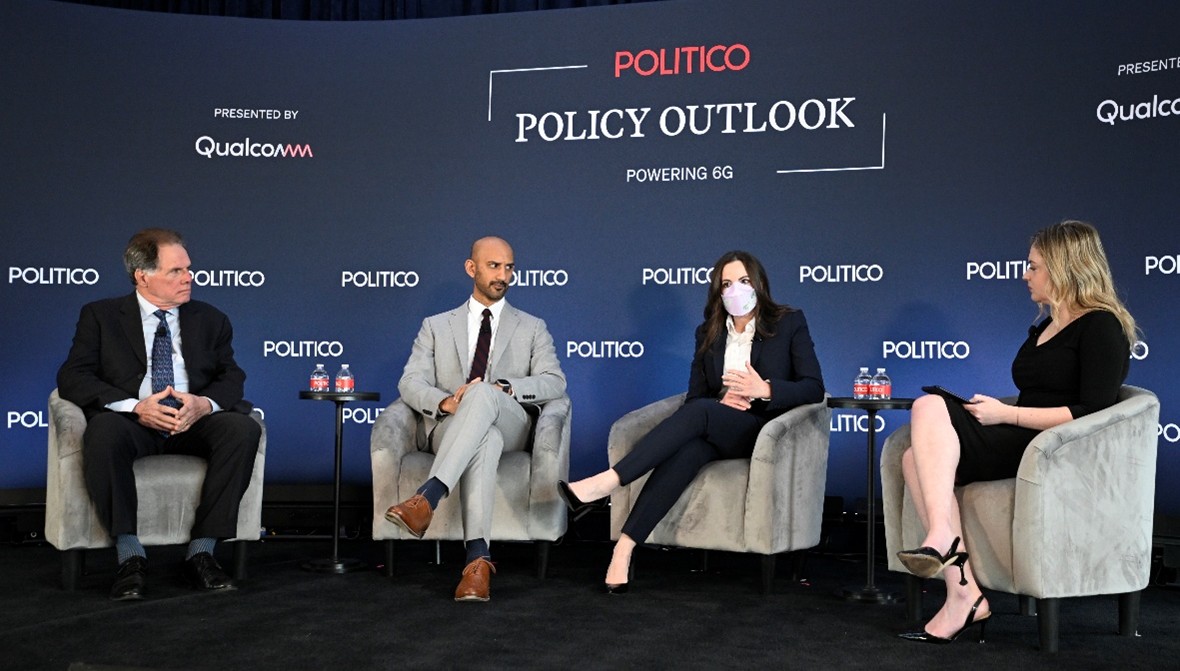
The next generation of mobile communications technology promises high-speed connectivity, near-instant latency, and new capabilities such as advanced sensing and immersive digital environments. As the United States seeks global 6G leadership, it faces fierce competition from the PRC, which is racing toward its own goal of 6G preeminence with help from the Shenzhen-based telecommunications giant Huawei.
Lindsay Gorman joined the POLITICO 6G summit in Washington, DC to explore issues at the forefront of telecommunications debates. Gorman spoke alongside Ranking Member of the Communications and Technology Subcommittee Rep. Doris Matsui (Democrat-California), Arielle Roth of the National Telecommunication and Information Administration, Michael Calabrese of New America, and Vivek Chilukuri of the Center for a New American Security.
Featured this Month
GMF Technology and GPPi Unpack European Technological Sovereignty Debate
Just as Europe has finally begun to come to terms with the need to reduce dependencies on the PRC—including in critical technology supply chains and infrastructure—the continent’s vulnerability to tech-enabled coercion from across the Atlantic has become clear. Increasing calls for European technological sovereignty focus largely on reducing Europe’s dependence in the United States.
GMF Technology convened key policy stakeholders in Berlin for a closed-door roundtable on the thorny issues underpinning calls for European technological sovereignty. Hosted in partnership with the Global Public Policy Institute (GPPi), the event featured GMF Senior Officer Sharinee Jagtiani, Jakob Hensing and Florian Klumpp of GPPi, and Ben Brake of DOT Europe. GMF Deputy Managing Director Astrid Ziebarth gave opening remarks.
Before the roundtable, Jagtiani and GMF China Technology Analyst Dylan Welch published “A Transatlantic Tech Partnership”, which charts a path for a transatlantic tech relationship of managed interdependence. They argue that a wholesale destruction of the transatlantic technology stack would be self-defeating for Europe and the United States. Brussels and Washington risk undermining their own competitiveness by recreating existing capabilities at the expense of cutting-edge innovation and shrinking the scale on which firms rely to finance research and development. In addition, they write, dependence on the PRC fundamentally differs from dependence on the United States given Beijing’s 2017 National Intelligence Law, blurred public-private boundaries, and lack of meaningful avenues to formally challenge state authority.
Lindsay Gorman and Sharinee Jagtiani Highlight Technical Solutions for “AI Unreality” in Politics
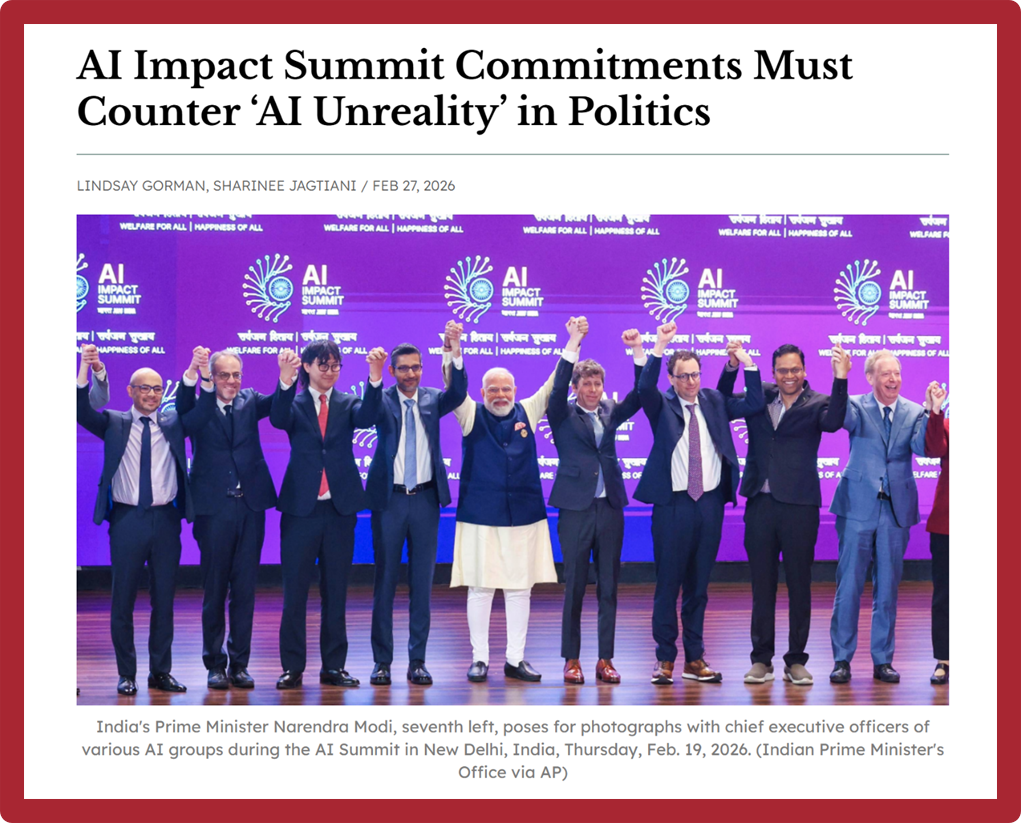
AI-generated content is now a fact of political life. Synthetic images of former Venezuelan leader Nicolás Maduro’s capture, videos of pro- and anti-government rallies in Iran, and clips of police arresting ICE agents in the New York subway are just a handful of the AI images and videos that have recently proliferated on the internet. New tools such as xAI’s Grok allow anyone with an internet connection to create fake but increasingly realistic depictions of world events. For democracies that protect free speech and rely on trustworthy information to guide political participation, countering “AI unreality” is crucial to safeguarding free societies.
Public interest technology that advances core democratic values must be part of the global AI deployment agenda, Lindsay Gorman and Sharinee Jagtiani argue in an op-ed for Tech Policy Press. Regulatory approaches alone are fundamentally reactive and often too slow to compete with internet virality. Instead, democracies need a larger toolkit to protect access to trustworthy information that embeds values including authenticity, provenance, and trust by design.
Democratic societies should embark on proactive innovation offensives against AI unreality, Gorman and Jagtiani argue. By creating product development guidelines, supporting rigorous red-teaming, and funding competitions, grants, and scholarships for democracy-affirming technologies, democratic societies can help separate fact from fiction at this key inflection point in AI deployment.
Adrienne Goldstein Outlines Paths for Transatlantic Cooperation on AI Safety
From Anthropic’s standoff with the Department of Defense to exits of top safety researchers at OpenAI and Anthropic, AI safety is at an inflection point in the United States. Actions such as refocusing the former AI Safety Institute on innovation and deprioritizing AI safety at the National Institute of Standards and Technology (NIST) have fueled European impressions that the United States is discarding AI safety. However, several US federal government policies from the past year include measures that fall under the umbrella of AI safety. These include deepfake guidelines, forensic benchmarks, and risk-management for federal agencies’ adoption of AI. Many US state and local governments have also implemented AI safety policies, although Trump’s executive order preempting state-level AI regulation may chill subnational efforts.
Senior Program Coordinator Adrienne Goldstein takes stock of the current state of US AI safety policy and assesses prospects for transatlantic cooperation in “Can the Transatlantic Community Align on AI Safety?”. While some European actors may perceive the United States as retreating from AI safety wholesale, she writes, AI safety is in fact a rare policy issue on which there has been regulatory momentum and even bipartisan agreement in Washington. This is the case particularly when the issue is framed in terms of specific concerns such as children’s safety or catastrophic risk. European stakeholders seeking common approaches and capacity sharing with the United States on AI safety should consequently frame opportunities for transatlantic cooperation not as AI safety initiatives but as efforts to address such specific issues of shared concern.
Media Mentions
Lindsay Gorman on DW News on Anthropic’s Standoff with the Pentagon
“These contract negotiations aren’t the right fora to be talking about these really salient issues about how we constrain and how we put guardrails [on AI]. … Ultimately, it really shouldn’t be the AI companies enforcing these things that are quite vital to democratic societies. We need to do better in terms of public conversation,” Gorman said on “Trump orders government to stop using Anthropic's AI”.
Byte-Sized Bulletin
A federal judge in San Francisco granted Anthropic’s request for a preliminary injunction against the Department of Defense in the legal battle over the Pentagon’s designation of the company as a supply chain risk, a label typically reserved for firms linked to foreign adversaries that pose national security risks. The dispute stems from Anthropic’s requirements that its systems not be used for mass domestic surveillance or lethal autonomous weapons.
The European Commission is funding PRC technology giant Huawei through 16 projects in its Horizon Europe research program, a POLITICO investigation found. The Commission banned Huawei from participating in the program’s innovation projects, which produce near-market ready outputs, in 2023 but continues to fund existing projects, some of which will last until 2030.
Meta unveiled four new in-house AI chips in its Meta Training and Inference Accelerator family, which will be used for tasks including image and video generation and large language model training. The announcement follows Meta’s more than $100 billion deal with Advanced Micro Devices (AMD), under which Meta will purchase AMD’s MI450 chips and acquire a roughly 10% stake in the semiconductor company.
The European Parliament's civil liberties committee approved a ban on the marketing of AI systems capable of generating sexualized deepfakes of real people. The move comes after Elon Musk’s chatbot Grok went viral for generating as many as 3 million such deepfakes, including alleged child sexual abuse material.
President Trump announced at a White House roundtable that seven US tech companies—Amazon, Google, Meta, Microsoft, OpenAI, Oracle, and xAI—agreed to cover the cost of energy to power their data centers. The voluntary pledge aims to rein in rising energy costs as public frustration mounts.
The Download
- Lindsay Gorman joined the Australian Strategic Policy Institute’s Stop the World podcast to discuss US AI competition with the PRC and the standoff between the Pentagon and Anthropic. Listen to the full episode here.
- Dylan Welch spoke at a GMF Alumni Leadership Council briefing on technological interdependence between the United States and Europe.
- Dylan Welch and Adrienne Goldstein hosted a group of Florida International University students to deepen their understanding of democracy-affirming technologies, China’s global digital footprint, and transatlantic AI policy and innovation.
- Program Coordinator Alexandra Pugh participated in Brave1’s defense tech demo day in Washington, DC, where Ukrainian startups showcased their technologies and provided insight into Ukraine’s defense innovation ecosystem.
GMF Technology is dedicated to ensuring that democracies together win the strategic technology competition with autocrats.
Alexandra Pugh coordinated this month’s TransatlanTech Insider.