The Europe-India Briefing—May 2026

Listen to this article
Audio is generated automatically and may contain minor inaccuracies.
Springtime for India and Europe
Indian Prime Minister Narendra Modi’s mid-May visit to Italy, the Netherlands, Norway—for the 3rd India-Nordic Summit—and Sweden was a rare occurrence. Indian prime ministerial visits to Europe are few and far between. The trip marked, for example, the first time in 43 years that an Indian prime minister visited Norway. Beyond pageantry and symbolism, and the occasional controversy, the visit reflected adjustments in Indian and European foreign policies to challenges posed by China and uncertainties in US foreign policy. It demonstrated the interest of smaller European capitals in engaging New Delhi. It also showed mutual European and Indian interest in expanding ties beyond trade to include defense industrial partnerships, emerging technologies and critical minerals.
Why is India focused on the countries Modi visited and why is this happening now? There are three reasons that make his travel notable.
First, European capitals and New Delhi are eager to exploit the momentum generated earlier this year by the EU-India summit and the announcement at that meeting of a free trade agreement (FTA) between the two. That momentum was given a further push when Modi met EU Commission President Ursula von der Leyen in Sweden to discuss next steps for deepening the EU-India relationship.
Second, the visit demonstrates that Indian diplomacy focuses on different tracks for engaging with Europe. India is building and expanding ties with European actors other than traditional partners such as France and Germany. The Netherlands, for instance, has emerged as India’s second-largest European trading partner (see graphic below) and is one of India’s biggest foreign investors. The Hague, joining Paris and Berlin, has played an outsized role in pushing for closer ties with India at the European level. Italy is now also quickly emerging as one of India’s key partners in Europe, particularly on defense.
India's Top European Trading Partners
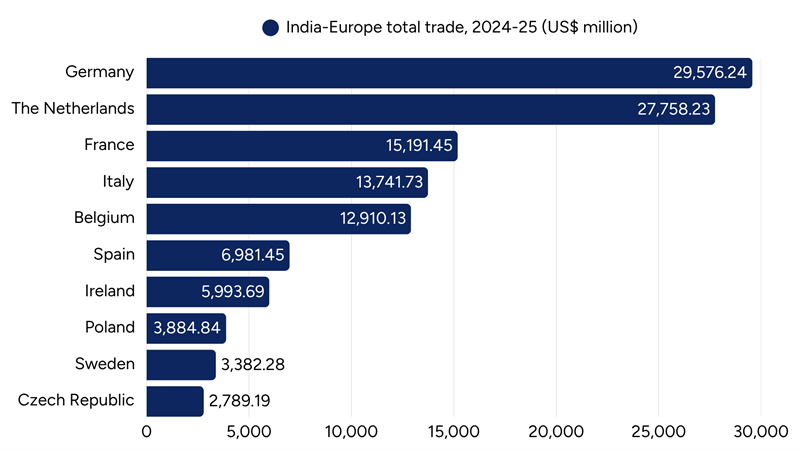
Credit: Data from the Indian Ministry of Commerce and Industry
Modi’s visit is an interesting showcase of India’s small-group diplomacy within Europe. Speaking about the India-Nordic Summit, a senior Swedish diplomat told me that “many countries are interested in engaging with the Nordics as a grouping now, including Japan [and] New Zealand ... But India was a fast mover here”. The first time the Nordics met as a group with a foreign leader was in 2016 with US President Barack Obama. The first India-Nordic summit took place in Stockholm shortly thereafter, in April 2018.
Third, even if travel dates had long been set, the Iran war shaped Modi’s conversations with his European counterparts. The closure of the Strait of Hormuz has underscored India’s vulnerabilities regarding energy, fertilizers, and food security. Shortly before commencing his trip, Modi, likening the energy crisis to the COVID-19 era, announced austerity measures. India’s search for new partners now has a real urgency. The global impacts of the war were a topic in every discussion the prime minister held.
Expanding Beyond Trade
For European partners, the visit was crucial for elevating their ambitions for ties with New Delhi and, in fact, upgrading them. The Netherlands and Sweden have a long history of working with India. Sweden’s companies have been present in India for a century, noted Prime Minister Ulf Kristersson in his meeting with Modi. But despite already robust partnerships, the leaders of both European countries signed “strategic partnership” agreements with India.
For The Hague, a Dutch official told me, the agreement is meant to expand ties with India beyond trade and investment to technology, security, and defense, and add “strategic anchors” to the relationship. For Stockholm, an official there shared, the pact is about matching India’s place in Swedish policy with the actual depth of the bilateral partnership. Sweden also hopes that upgrading the relationship will make it a more attractive partner for New Delhi, where several European capitals are jostling for importance.
Given India’s considerable security needs, the country’s push to diversify defense partnerships with Western partners, and Indian companies’ interest in joining the European defense market, security cooperation has become a surefire way of generating interest in New Delhi. Sweden’s Saab has established its Carl-Gustaf M4 weapons system manufacturing plant in Haryana, the firm's first such facility outside its home base and the first in India from a defense company under the 100% foreign direct investment (FDI) route. The Netherlands and Italy also used Modi’s visit to announce defense industrial “roadmaps” with India. The prime minister’s trip also resulted in agreements to hold regular dialogue among European and Indian national security advisers, upgrade ties among militaries, and hold port visits, all to strengthen security cooperation.
Trade, Tech, Talent
What are India’s goals for engaging this particular set of countries? A senior foreign ministry official described them as the three T’s—trade, technology, and talent flows.
On top of its FTA with the EU and a trade agreement with the states of the European Free Trade Association (Iceland, Liechtenstein, Norway, and Switzerland), New Delhi is focused on building trade and investment ties with European capitals across the board. It seeks to attract investment, including in capital markets and advanced manufacturing. Modi’s visit was notable for his meetings with CEOs at every stop and with the European Roundtable for Industry, when he pitched India as the “world’s most attractive destination for investment, innovation, and manufacturing”. India has seen limited success in capturing the “China plus one” investment shift that has led to some internal reforms to attract FDI, increase openness toward FTAs, and forge a renewed push to engage international partners.
Modi’s visit also focused on broadening technology cooperation beyond the United States in areas ranging from green tech to defense tech, and he scored some successes. Dutch chipmaker ASML and Tata Electronics announced an agreement to build India’s first front-end semiconductor fab. A Sweden-India Technology and Artificial Intelligence Corridor will drive collaboration on artificial intelligence (AI), health tech, and green mobility. Digital infrastructure, AI-enabled networks, and 5G/6G transitions featured in conversations with Nordic officials and representatives.
On green tech, an area in which India’s desire to move up the manufacturing chain aligns with Europe’s de-risking push, there were additional announcements about offshore wind, solar, and battery technology cooperation, especially with the Nordic countries. The Netherlands and Sweden will also work with India on advanced mining and mineral processing technologies to facilitate efficient extraction from low-grade and complex critical mineral deposits.
De-risking Impulses
The visit was occasionally clouded by concerns about press freedom and minority rights in India, which spurred pointed rebuttals by the country’s foreign ministry. Yet European leaders across the board called India a “like-minded partner” in defending the rules-based international order against those who, as the Norwegian Prime Minister Jonas Gahr Støre noted, “weaponize diplomacy, weaponize trade, and weaponize technology”.
European policymakers I spoke with also underlined that de-risking from China is a key argument for stronger ties with India. Nudging European companies to invest in and build technology cooperation with the country is a direct result of this de-risking impulse. And “de-risk and diversify” is a mantra that intersects neatly with India’s own strategy given competition with China and the tensions in the relationship with the United States. This convergence helps to manage differences Europe and India may have on other issues.
What to Watch
In her meeting with Modi, von der Leyen declared that Brussels’ goal was to sign the EU-India FTA and hold a Europe-India business summit by the end of the year. She made the case for concluding an investment agreement that was initially being negotiated in parallel with the FTA. “The FTA has opened the door, the investment agreement will walk us through it”, she remarked. The EU clearly wants its negotiating partner, India’s finance ministry, to finalize a deal. Watch for any signs of progress on this front.
The next meeting of the EU-India Trade and Technology Council takes place in Brussels in July. Watch for the unveiling of its new format, which should focus more strongly on advanced technologies such as AI.
Follow and subscribe to this bimonthly newsletter tracking developments in the Europe-India relationship. The next edition will delve into Franco-Indian ties.
The views expressed herein are those solely of the author(s). GMF as an institution does not take positions.