A New Connectivity Hub

Listen to this article
Audio is generated automatically and may contain minor inaccuracies.
Just days before Armenia’s June 7 parliamentary election, US Secretary of State Marco Rubio visited Yerevan to sign a strategic partnership agreement. He also finalized additional accords on critical minerals and the development of the Trump Route for International Peace and Prosperity (TRIPP) corridor linking Armenia to other Europe–Asia transport routes. Rubio’s travels underscore that connectivity in the South Caucasus is increasingly being treated not as a regional issue, but as part of a wider effort to diversify trade routes and reduce dependence on corridors affected by war, geopolitical disruption, and other strategic vulnerabilities.
The results of Armenia’s election consequently resonate far beyond domestic politics. The outcome will help determine the extent to which Armenia can advance regional connectivity initiatives and international partnerships as unresolved frozen conflicts and their ensuing instability continues to plague the South Caucasus.
The Upheaval of War
Russia’s full-scale invasion of Ukraine fundamentally reshaped European thinking about infrastructure, energy, and regional security. Trade routes once taken for granted became vulnerable overnight. Maritime insecurity, sanctions, disrupted logistics, and broader geopolitical tensions accelerated the search for alternative corridors connecting Europe to the South Caucasus, Central Asia, and beyond. On the western side of the Black Sea, new forms of regional cooperation are already emerging. The Odessa Triangle is strengthening connectivity and cooperation among Moldova, Romania, and Ukraine, while Bulgaria, Romania, and Türkiye collaborate in a new EU Maritime Security Hub in Constanța. Similar coordination will likely be necessary in the South Caucasus if broader connectivity projects are to materialize.
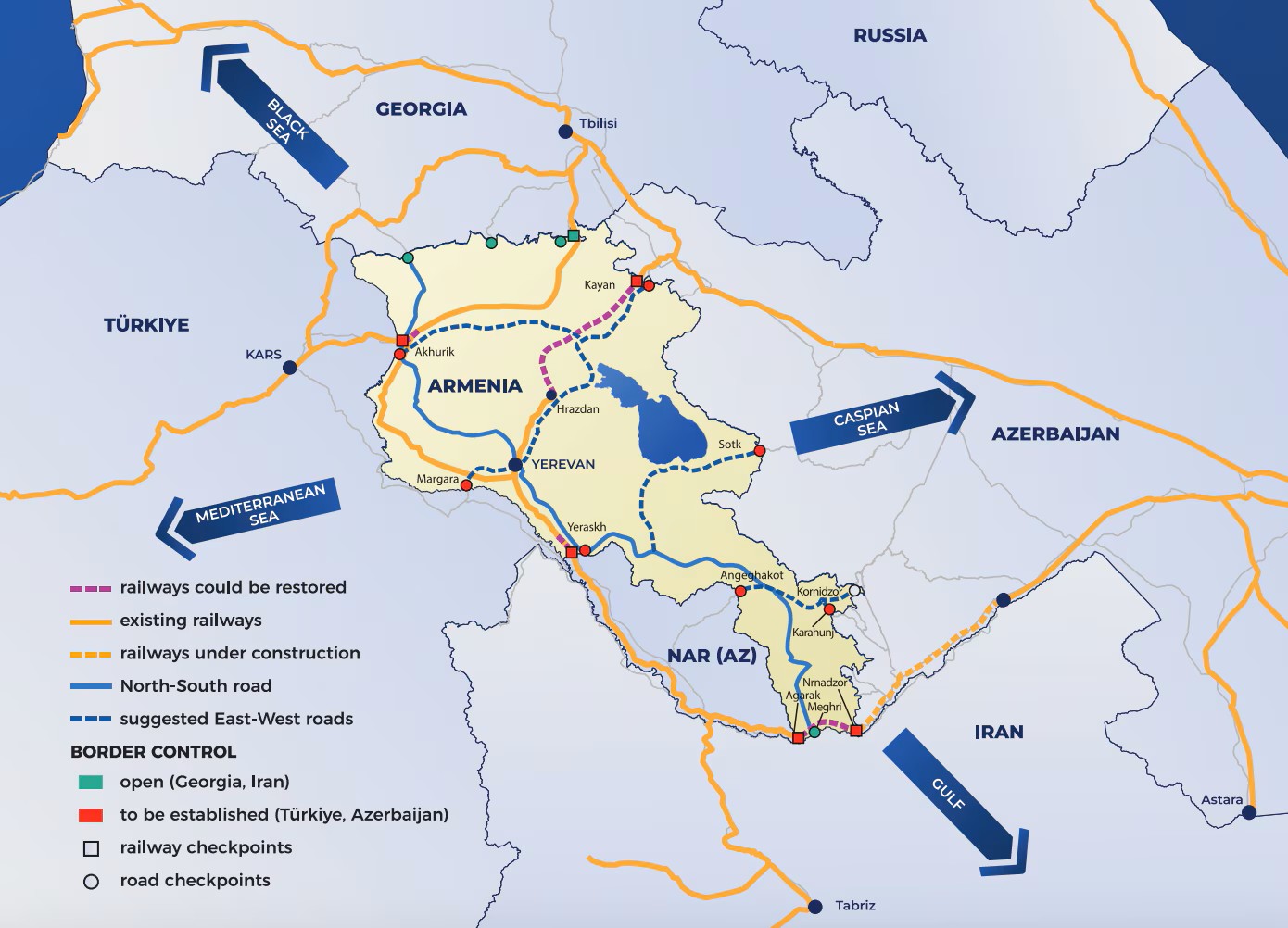
Recent policy discussions in Yerevan and Washington increasingly reflect the strategic shift. The Black Sea is emerging as a space where questions of connectivity, security, and regional influence converge. As illustrated in Figure 1, Armenia is becoming part of wider debates about Europe’s future connectivity architecture linking the Black Sea, the South Caucasus, and Central Asia. Initiatives such as Armenia’s Crossroads of Peace proposal, the Middle Corridor, and broader Black Sea connectivity frameworks are increasingly being discussed not as isolated regional projects, but as components of a larger Euro-Atlantic effort to strengthen economic resilience, diversify trade routes, and reduce strategic vulnerabilities. As a result, the debate is no longer whether Europe should invest in connectivity across the South Caucasus, but how these initiatives can be implemented in a sustainable and inclusive manner.
Figure 1: Armenia's Crossroads of Peace initiative
Credit: World Economic Forum (2024)
Much of this new momentum emerged after the 2025 Armenia–Azerbaijan peace agreement, which significantly changed US and European policymakers’ views of the South Caucasus. The accord left major political and security obstacles unresolved, but it reopened discussions about regional transport corridors, the normalization of relations between Yerevan and Ankara, and Armenia’s role in Europe–Asia connectivity frameworks. The country’s geographic position gives it strategic relevance to emerging east–west trade corridors.
Come Together
Connectivity is not only about infrastructure. It is increasingly about resilience: diversified trade routes, reduced strategic dependencies, supply-chain security, and the political orientation of entire regions. Discussions with transatlantic and South Caucasus stakeholders reveal the importance of ensuring that infrastructure projects in the latter region strengthen integration, not deepen geopolitical fragmentation. Transport corridors, railways, ports, energy interconnectors, and logistics hubs are, after all, never politically neutral. They shape long-term political and economic alignments and influence integration into wider regional systems. For Armenia, this creates opportunities and vulnerabilities. The country is at the intersection of competing geopolitical pressures as it attempts to deepen relations with the EU, strengthen democratic institutions, and reduce strategic isolation. Under these conditions, connectivity initiatives become inseparable from the issues of sovereignty, long-term stability, and geopolitical orientation.
Armenia’s election cannot be separated from these regional dynamics. It is more than a routine domestic contest, and the results will shape Armenia’s geopolitical and economic orientation when the country is increasingly being seen as part of emerging Black Sea and Europe–Asia connectivity frameworks. Prime Minister Nikol Pashinyan has described regional normalization, reopened transport links, and deeper engagement with Europe and the United States as necessary for his country’s long-term security and development, particularly after the 2025 peace agreement with Azerbaijan helped elevate Armenia’s role in regional connectivity. Opposition forces, many of whom are skeptical of Yerevan’s rapid westward reorientation and closer ties with Azerbaijan and Türkiye, argue that the government is making excessive concessions in exchange for uncertain regional integration benefits. The election outcome will, therefore, impact efforts such as the Crossroads of Peace initiative, the reopening of regional transport corridors, and Armenia’s integration into Black Sea and Middle Corridor connectivity structures.
Armenia's connectivity ambitions indeed face important constraints. Stakeholder discussions highlight unresolved challenges, including how infrastructure projects can remain economically viable without becoming politically exclusionary and how Western actors can support regional connectivity without reinforcing geopolitical fragmentation. Lasting economic integration will require sustained political normalization, investment, and regional cooperation.
Armenia was for decades viewed primarily through the lens of conflict, vulnerability, and regional instability. Today, it is increasingly attracting attention for its potential to connect. The entire South Caucasus is similarly, if gradually, becoming part of the wider Black Sea region, where transport corridors, energy routes, and supply chains are reshaping international relationships.
Armenia is emerging as a test case for connectivity’s ability to serve economic objectives while fostering regional stabilization through political cooperation. The challenge for the country, its neighbors, and its transatlantic partners is no longer identifying opportunities for connectivity but translating them into durable arrangements that can outlast the geopolitical shocks that created them.
This text draws on discussions held during a pre-election study visit to Armenia, including the Yerevan Dialogue 2026 conference and subsequent meetings in Washington, DC with Armenian experts, congressional staff, policymakers, civil society representatives, and foreign policy practitioners. These engagements were organized with the support of GMF under the StrengthEU program funded by the Swedish Ministry for Foreign Affairs.
The views expressed herein are solely those of the author(s). GMF as an institution does not take positions.