France’s Diplomatic Ambiguity in Action

In the aftermath of the coordinated US-Israeli attack on Iran on February 28, France found itself in a difficult position: compelled to respond to a conflict it had neither shaped nor been consulted about. The official response from Paris in the days that followed was a study in diplomatic ambiguity. It was critical of the war’s apparent lack of a legal basis, but did not overtly condemn Washington and Tel Aviv. At the same time, Paris was unequivocal in placing primary responsibility for the war on Tehran. The initial reaction reflects broader tensions characterizing France’s relationship with Washington, as well as ongoing efforts by Paris to chart a more autonomous path.
The outbreak of another war in the Middle East forced Paris into a reactive posture. As French President Emmanuel Macron stated at the outset of the conflict, France was “neither informed [about] nor involved” in US and Israeli strikes against Iran—implicit criticism of Washington’s unilateralist tendencies and their consequences. Indeed, Iran’s military retaliation has had broad regional implications, including for French interests. To date, the government has had to evacuate some 20,000 French nationals scrambling to flee the region; some 400,000 French citizens lived in or were visiting countries in the Middle East when the war broke out. In the UAE, which has faced the majority of Iranian attacks, two French bases came under attack in the initial days of war, though it is unclear if they were deliberately targeted.
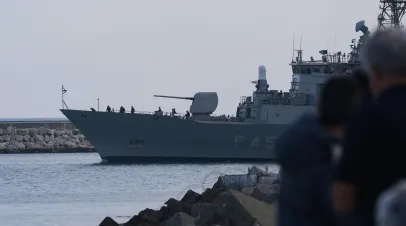
France’s broader foreign policy interests are also not served by this war. The outbreak of renewed conflict in the Middle East has undermined the role of international institutions in war authorization, weakened the role of diplomacy in conflict resolution, and drawn attention and resources away from Ukraine. Rising commodity prices and trade blockages, meanwhile, can prove useful to Russia. Last week, the United States issued a 30-day waiver to India to purchase Russian oil. Macron has thus far rejected any lifting of economic sanctions on Russia and has announced a future French mission to escort oil tankers through the Strait of Hormuz, which the Iranians have effectively closed to maritime traffic. However, as prior counter-Houthi maritime operations in the Red Sea have shown, confronting asymmetric warfare is a tough task. It relies on effectively removing both immediate threats and the potential of future threats. Despite a halt in Houthi attacks, traffic through the Suez Canal has not recovered to mid-2023 levels. In the first week of 2026, shipping was still down 60% compared to the first week in 2023.
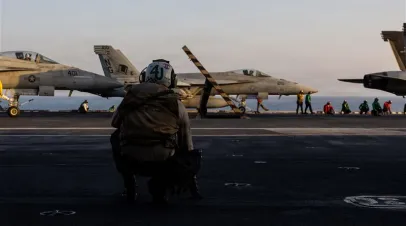
Macron’s announcement, however, serves other important purposes. First, it seeks to reassert Paris’ claim to leadership within Europe’s security architecture at a moment when the continent finds itself, once again, sidelined by Washington. After a UK base in Cyprus was hit by an Iranian drone, it was Macron—not British Prime Minister Keir Starmer—who visited and promised to protect the island. Second, the announcement and the already deployed naval and aerial assets enable Paris to claim operational involvement in a region-defining war—albeit framed as a defensive rather than offensive effort to avoid additional parliamentary scrutiny. As Macronsaid on Wednesday, “We aren’t participating in an ongoing conflict, but operating in this framework.” Macron's careful wording also laid bare a harder truth: that however France positions itself, the fundamental decisions about the war's trajectory—how and when it ends—remain in American hands.
The views expressed herein are those solely of the author(s). GMF as an institution does not take positions.
Related Content